
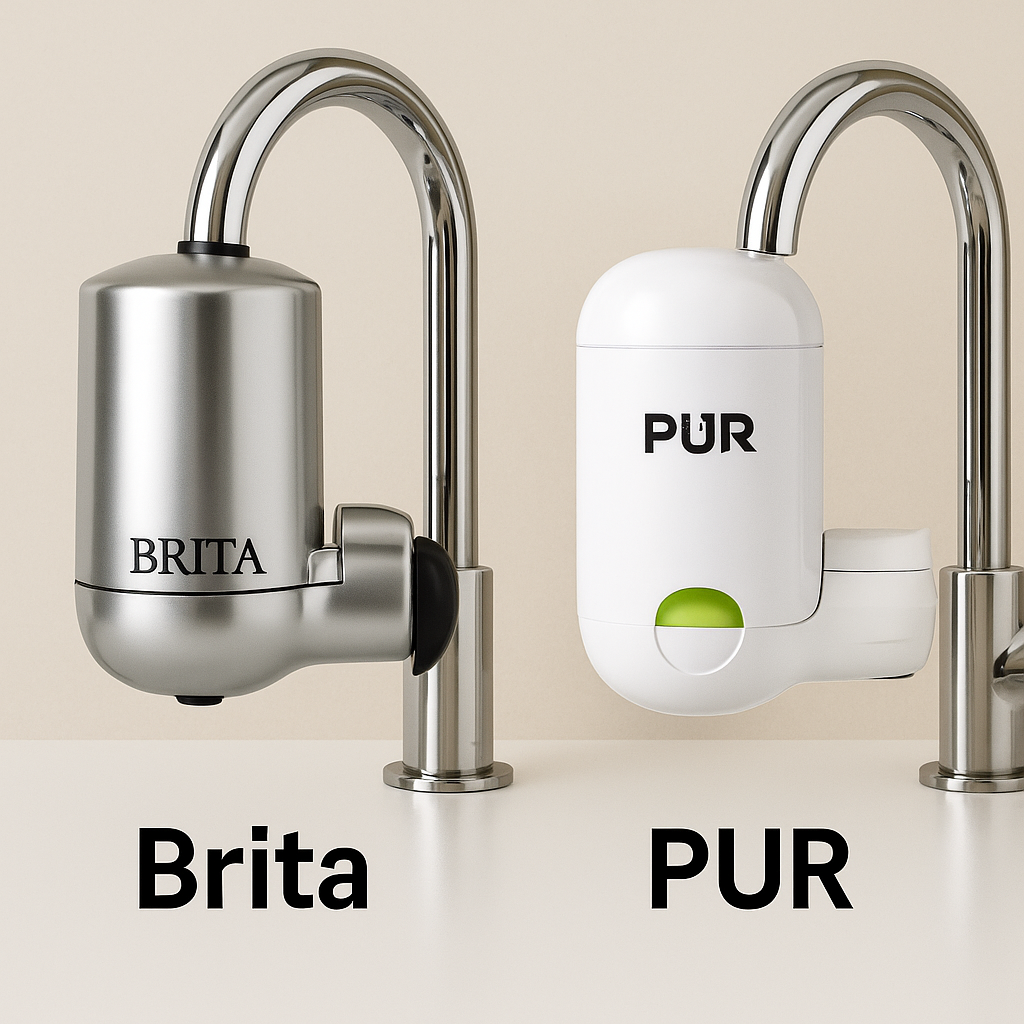
Faucet-mounted filters are a popular choice for people who want cleaner drinking water without investing in under-sink or countertop systems. Two of the most recognized brands in this category are Brita and PUR. Both offer compact, easy-to-install systems that attach directly to your kitchen faucet and provide on-demand filtered water. But which one is actually easier to use on a day-to-day basis?
In this guide, we compare the Brita and PUR faucet filters side by side—breaking down how they stack up when it comes to installation, usability, filter changes, taste, maintenance, and price. Whether you’re choosing your first filter or upgrading from a basic model, this article will help you make the right call for your kitchen.
Disclosure: As an Amazon Associate, we earn from qualifying purchases. This post may contain affiliate links that help support our content at no additional cost to you.
🔧 Installation Comparison

Brita Faucet Mount System (Basic Model)
Amazon Rating: 4.5 out of 5 stars
View on Amazon
Brita’s system is designed for users who want a no-fuss installation. The faucet mount comes with multiple adapters and fits most standard faucets without the need for tools. The included instruction guide is straightforward, making the entire setup process intuitive—even for first-timers.
Once you click the unit into place, it’s securely fastened and ready to use in under five minutes. A simple switch on the side allows you to toggle between filtered and unfiltered water, making it a great solution for everyday kitchen use. The unit is relatively compact and doesn’t obstruct other sink functions. However, those with non-standard or pull-down faucets may face compatibility issues. The instructions are clearly written, and the filter clicks into place with a reassuring snap. One downside is that users with uniquely shaped or spray-type faucets may need extra adapters or find compatibility tricky.

PUR PLUS Faucet Mount Filter (FM-3700B)
Amazon Rating: 4.6 out of 5 stars
View on Amazon
The PUR PLUS system features a similarly tool-free installation process and includes a wide array of adapters for different faucet styles. The unit is a bit larger than Brita’s, which may pose clearance issues in tight sink spaces, but the added size translates to more robust construction and a stylish chrome finish.
Installing the unit is simple once the correct adapter is in place, though it may require a bit more force to fully secure. Once attached, it provides a tight seal that minimizes leaks—assuming the adapter is properly fitted. The toggle switch between filtered and tap water is responsive, and users appreciate the solid build quality. Like Brita, compatibility with sprayer-style faucets is limited, so checking your faucet type beforehand is recommended. The unit feels sturdy and the chrome finish looks sleek. However, the size may interfere with low-clearance sink spaces. Once installed properly, switching between filtered and unfiltered water is simple.
Installation Winner: Brita — Easier and quicker for most standard faucets.
💧 Filtration & Taste Performance
Brita
Brita’s carbon block filter is designed to improve tap water by reducing common contaminants such as chlorine (for taste and odor), lead, asbestos, and some particulates. It meets NSF/ANSI Standards 42 and 53, which cover aesthetic effects and health effects respectively. While it doesn’t filter as broad a range as PUR, it still handles the major culprits that affect taste and health.
Users report a noticeable improvement in water flavor, and it’s especially effective at neutralizing chlorine taste. The flow rate is steady, though it might take a moment to kick in after toggling to filtered mode. One limitation is that Brita’s filter isn’t certified for removing some emerging contaminants like pharmaceuticals.
PUR
The PUR PLUS uses a two-stage filtration system that combines activated carbon with ion exchange. This setup allows it to tackle over 70 contaminants, including lead, mercury, chlorine, industrial pollutants, pesticides, and certain pharmaceuticals. It meets NSF/ANSI Standards 42, 53, and 401, placing it among the most thorough filters in this category.
Taste tests regularly place PUR ahead of the competition. Water comes out crisp, clear, and free of odors. The added filtration, however, may slightly reduce flow rate, and the filter can clog prematurely if local water is especially dirty. Despite this, PUR remains a top pick for households with serious water quality concerns.
PUR’s MineralClear filter uses both activated carbon and ion exchange to reduce over 70 contaminants, including lead, mercury, pesticides, and more. It’s certified under NSF standards 42, 53, and 401—offering a broader scope of protection.
Taste results are among the best in its class, and the filter has been widely praised for removing unpleasant odors and flavors.
Filtration Winner: PUR — Filters more contaminants and produces cleaner-tasting water.
🔁 Filter Replacement & Maintenance
Brita
Replacing a Brita faucet filter is a simple, quick process that doesn’t require tools or guesswork. The unit has a built-in indicator that uses a light or calendar wheel to signal when a filter change is due, generally every 100 gallons or about every 3–4 months depending on usage.
Filters are readily available and competitively priced. Brita also offers multi-pack discounts which further reduce long-term cost. One downside is that the filter status indicator isn’t always perfectly accurate, and some users may forget to reset it after changing filters.
PUR
PUR’s filter changes require a little more effort and precision. The cartridge fits snugly, but aligning it can be tricky the first few times. An LED indicator offers a clearer, more automated alert system that blinks red when a change is needed—adding convenience for busy users.
The filters are effective but cost slightly more than Brita’s. Additionally, some users have reported the indicator malfunctioning over time, requiring manual tracking of replacement schedules. Overall, the system is manageable, but not quite as beginner-friendly as Brita’s.
PUR filters are slightly trickier to replace, requiring a little more force and alignment. The indicator light is more advanced and blinks when the filter is nearing end-of-life.
However, PUR’s filters are typically a bit more expensive than Brita’s.
Maintenance Winner: Brita — Easier to replace and more budget-friendly.
📊 Head-to-Head Comparison Table
| Feature | Brita Faucet Filter | PUR PLUS Faucet Filter |
|---|---|---|
| Installation | Very easy, 1-click design | Simple but slightly bulkier |
| Filtration Standards | NSF 42, 53 | NSF 42, 53, 401 |
| Contaminants Removed | 60+ | 70+ |
| Filter Change Indicator | Yes | Yes (LED light) |
| Filter Life | 100 gallons | 100 gallons |
| Replacement Cost | Lower | Higher |
| Taste Improvement | Good | Excellent |
| Size & Design | Compact | Larger, more robust |
🏆 Best For…
- Best for Small Sinks: Brita Faucet Filter
- Best for Comprehensive Filtration: PUR PLUS
- Best for Budget-Conscious Buyers: Brita
- Best for Taste Improvement: PUR PLUS
- Best for Ease of Use: Brita
Final Thoughts
Both the Brita and PUR faucet-mounted filters offer impressive upgrades over unfiltered tap water—but they serve slightly different audiences. Brita is best suited for those who want a compact, affordable, and user-friendly solution. It’s quick to install, simple to maintain, and delivers noticeable improvements in water taste.
On the other hand, PUR is ideal for users who want the most thorough filtration and don’t mind a slightly bulkier unit. With broader NSF certifications and a more advanced filter system, PUR offers higher performance—especially for households concerned about multiple contaminants.
In the end, you can’t go wrong with either choice. Choose Brita for simplicity and savings. Choose PUR if filtration performance is your top priority.
Head back to Faucet-Mounted Filters