Bottom Line Up Front: Regular cleaning isn’t just about hygiene—it’s about protecting your investment and ensuring every cup tastes as incredible as it should. Most coffee taste problems and machine failures stem from one thing: inadequate cleaning. Follow our science-backed maintenance schedule, and you’ll extend your machine’s life by up to 50% while brewing consistently exceptional coffee.
We’ve all been there—that first sip of morning coffee that tastes more like disappointment than the perfect wake-up call you were expecting. But here’s what most coffee lovers don’t realize: 90% of coffee taste is affected by the cleanliness of the brewing equipment, and over 60% of espresso machine malfunctions are linked to limescale buildup.
Here at HydroBrewLab, we test, we compare, we care, and most of all, we listen to the community about what really works for maintaining coffee equipment. Through real-world testing and countless conversations with home baristas, we’ve developed this comprehensive maintenance guide that goes beyond surface-level advice to give you the exact schedule your machine needs to brew smarter, taste better, and last longer.
Disclosure: As an Amazon Associate, HydroBrewLab earns from qualifying purchases. We only recommend products we’ve thoroughly tested and believe provide genuine value to our community. Your support helps us continue providing unbiased, data-driven reviews.
The Science Behind Coffee Machine Maintenance
Before diving into schedules, let’s understand what’s actually happening inside your coffee machine. Every time you brew, three types of buildup accumulate:
1. Coffee Oil Residue Coffee oils become rancid within 24-48 hours, creating bitter, off-flavors that contaminate every subsequent brew. These oils coat internal surfaces and are particularly problematic in espresso machines where high pressure forces them deep into components.
2. Mineral Scale Deposits Water contains dissolved minerals like calcium and magnesium. As water heats and evaporates, these minerals crystallize into hard deposits called limescale. This buildup clogs internal passages, reduces heating efficiency, and can eventually destroy your machine’s heating elements.
3. Bacterial Growth Espresso machines used daily without proper cleaning can harbor up to 50 different types of bacteria in the drip tray alone. Warm, moist environments with organic matter (coffee residue) create perfect breeding grounds for harmful microorganisms.
Understanding these factors helps explain why different cleaning tasks need different frequencies—and why skipping maintenance isn’t just about taste, it’s about health and equipment longevity.
The Ultimate Coffee Machine Cleaning Schedule
Daily Maintenance (After Each Use)
For All Coffee Machines:
Rinse removable parts immediately – Coffee oils oxidize rapidly, so quick rinsing prevents stubborn buildup
Empty and rinse water reservoir – Stagnant water breeds bacteria and algae
Wipe exterior surfaces – Coffee splashes contain oils that attract dust and become sticky
Leave reservoir lid open – Air circulation prevents moisture buildup and bacterial growth
For Espresso Machines (Additional Tasks):
Backflush group head with water – Run 2-3 seconds of water through the group head without portafilter
Purge steam wand – Release steam for 1-2 seconds to clear milk residue from internal passages
Wipe steam wand exterior – Use a dedicated damp cloth to remove milk residue before it hardens
Clean and dry portafilter and basket – Coffee oils concentrate here and affect extraction
For Drip Coffee Makers:
Remove and rinse filter basket – Even permanent filters need daily rinsing to prevent oil buildup
Wash carafe with warm soapy water – Coffee stains aren’t just aesthetic—they affect taste
Wash all removable parts with soap – Weekly deep cleaning removes oils that water rinsing can’t eliminate
Descale check – Look for visible mineral deposits as early warning signs
Clean water reservoir thoroughly – Scrub with bottle brush to remove algae and mineral deposits
Replace water if stored in reservoir – Fresh water prevents stale tastes and bacterial growth
Espresso Machines (Additional Tasks):
Backflush with cleaning solution – Use espresso machine cleaner to remove coffee oils from internal passages
Deep clean milk system – Run milk cleaning cycle if available, or soak removable parts in dairy cleaner
Check and clean drip tray – Remove, wash, and sanitize the drip tray and its housing
Clean bean hopper – Remove oils and chaff that accumulate from coffee beans
Pour-Over and Manual Brewers:
Deep scrub with coffee cleaner – Use specialized cleaners to remove stubborn coffee oil residue
Check for mineral deposits – Even manual brewers can develop scale in metal components
Sanitize with hot water rinse – Final hot water rinse eliminates cleaning residue
Monthly Comprehensive Maintenance
Descaling (Frequency varies by water hardness – see chart below) This is the most critical monthly task. Descaling removes mineral deposits that:
Reduce heating efficiency by up to 25%
Restrict water flow, affecting extraction
Eventually destroy heating elements and pumps
Create bitter, metallic off-flavors
Complete System Clean:
Remove and inspect all accessible components – Look for wear, damage, or excessive buildup
Clean internal water pathways – Run cleaning cycles specific to your machine type
Replace water filters – Most filters should be changed every 2-3 months
Calibrate if applicable – Some machines need recalibration after deep cleaning
Professional Assessment:
Document performance changes – Note any changes in brew time, temperature, or taste
Check warranty requirements – Some warranties require professional servicing
Plan for seasonal deep cleaning – Quarterly professional service for high-end machines
Descaling Schedule by Water Hardness
Water hardness is the single biggest factor determining descaling frequency. Here’s your personalized schedule:
How to Test Your Water Hardness
Option 1: Water Test Strips Simple, affordable strips that change color based on mineral content. Available at hardware stores or online.
Option 2: Contact Water Utility Most utilities provide annual water quality reports with hardness information.
Option 3: Professional Testing For precise measurements, especially important for expensive espresso machines.
Descaling Frequency Chart
Water Hardness
ppm (mg/L)
Grains per Gallon
Descaling Frequency
Very Soft
0-60
0-3.5
Every 6 months
Soft
61-120
3.6-7.0
Every 4 months
Moderately Hard
121-180
7.1-10.5
Every 2-3 months
Hard
181-250
10.6-14.6
Every 1-2 months
Very Hard
251+
14.7+
Monthly or more
Usage Adjustments:
Heavy use (6+ cups daily): Descale 50% more frequently
Light use (1-2 cups daily): Can extend intervals by 25-50%
Filtered water: Reduces frequency but doesn’t eliminate need
Water Quality Solutions
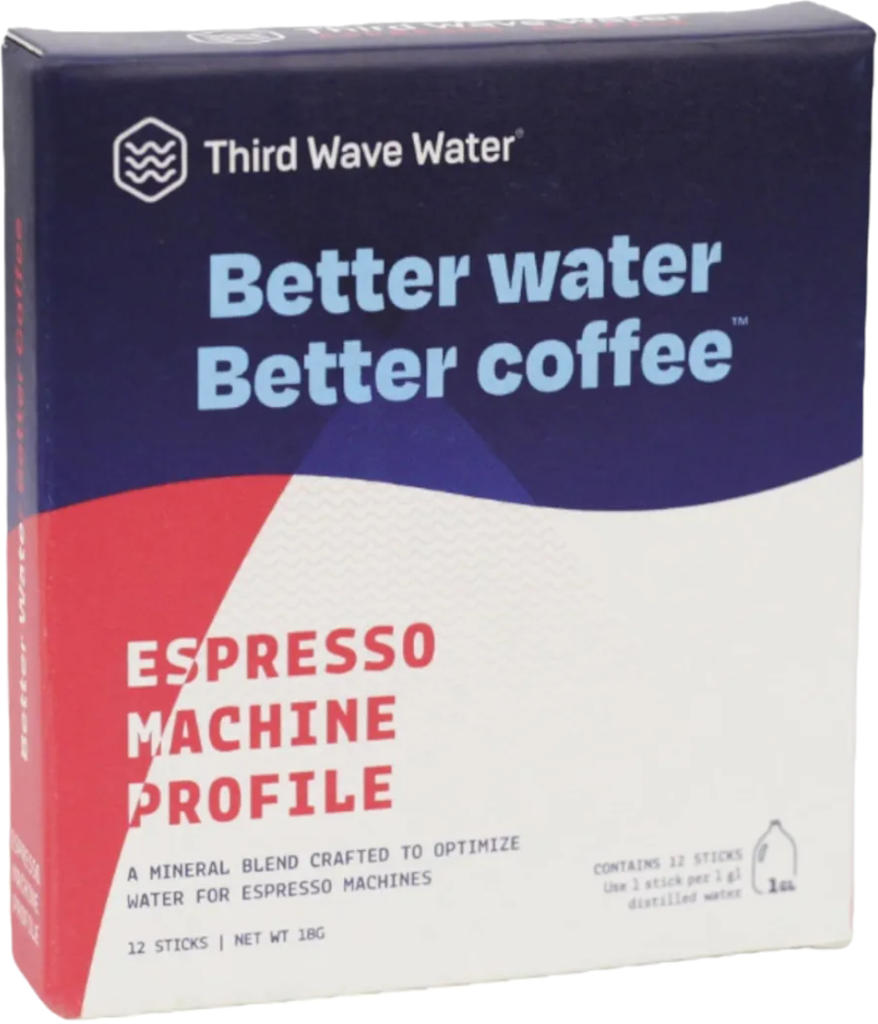
Third Wave Water Espresso Profile 4.6/5 stars View on Amazon Mineral packets designed specifically for espresso brewing. Creates optimal water composition for extraction while reducing descaling frequency by balancing essential minerals.
Warning Signs You’re Not Cleaning Enough
Taste Indicators
Bitter or Astringent Coffee Rancid coffee oils create harsh, unpleasant flavors that no amount of fresh beans can overcome. If your coffee tastes bitter despite proper brewing parameters, cleaning is overdue.
Sour or Off Flavors Bacterial growth in water reservoirs and drip trays can create sour, musty, or generally “off” flavors that contaminate every cup.
Metallic Taste Heavy mineral buildup can create metallic flavors, especially in machines with exposed heating elements.
Weak or Under-Extracted Coffee Scale buildup reduces water temperature and flow rate, preventing proper extraction even with correct coffee-to-water ratios.
Performance Indicators
Slower Brewing Times Mineral scale buildup can clog water flow, causing longer brew cycles and incomplete extraction. If your machine takes noticeably longer to brew, descaling is critical.
Inconsistent Water Temperature Scale on heating elements reduces efficiency, causing temperature fluctuations that ruin extraction consistency.
Unusual Noises Grinding, gurgling, or unusual pump noises often indicate scale buildup forcing components to work harder.
Steam Wand Issues Reduced steam pressure or milk that won’t froth properly usually indicates milk protein buildup in steam pathways.
Visual Indicators
White Mineral Deposits Visible scale on external surfaces means internal buildup is much worse. Don’t wait—descale immediately.
Coffee Oil Stains Brown, oily residue that doesn’t rinse away with water indicates deep cleaning is needed.
Algae or Slime in Reservoir Green or slimy buildup in water reservoirs poses serious health risks and indicates inadequate cleaning.
Clogged Components Visible blockages in shower screens, portafilter baskets, or drip mechanisms require immediate attention.
Professional Cleaning Product Arsenal
Daily and Weekly Cleaners
Urnex Cafiza Espresso Machine Cleaning Powder 4.6/5 stars View on Amazon Professional-grade cleaner that removes coffee oils and residue. NSF certified and used by baristas worldwide. Essential for weekly backflushing and monthly deep cleaning cycles.
ACTIVE Espresso Machine Cleaning Tablets 4.5/5 stars View on Amazon Convenient tablet form makes measuring easy. Compatible with all major espresso machine brands. Each tablet provides one complete cleaning cycle.
Descaling Solutions
ACTIVE Coffee Machine Descaler 4.4/5 stars View on Amazon 32oz bottle provides 8 complete descaling cycles. Works effectively without harsh chemicals and leaves no aftertaste. Compatible with all coffee and espresso machines.
Coffee Machine Cleaner Descaler Tablets 4.4/5 stars View on Amazon 34-count tablet pack offers excellent value for frequent cleaners. Compatible with all major brands including Keurig, Nespresso, Breville, and DeLonghi.
Specialized Cleaners
Urnex Rinza Acid Cleaner 4.8/5 stars View on Amazon Specialized cleaner for milk lines and steam wands. Removes milk protein and fat buildup that water cleaning can’t eliminate. Essential for machines with automatic milk systems.
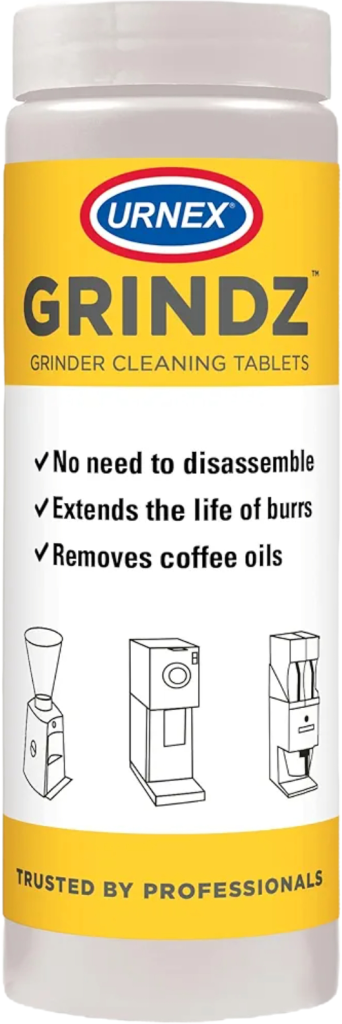
Grindz Coffee Grinder Cleaning Tablets 4.7/5 stars View on Amazon Food-safe tablets that clean grinder burrs and chambers. Removes coffee oil buildup that affects grind consistency and flavor. Run monthly for optimal grinder performance.
Machine-Specific Cleaning Protocols
Drip Coffee Makers
Daily: Rinse carafe and filter basket immediately after use. Wipe exterior and heating plate.
Weekly: Wash all removable parts with soap. Check for mineral deposits on heating plate.
Monthly: Descale with vinegar solution (1:1 ratio) or commercial descaler. Run 2-3 rinse cycles.
Signs of Problems: Slow brewing, coffee tastes bitter, visible scale on heating plate.
Espresso Machines
Daily: Backflush group head, purge steam wand, clean portafilter and basket.
Weekly: Backflush with cleaning powder, deep clean milk system, wash drip tray.
Monthly: Descale according to water hardness, replace water filter, professional inspection for high-end machines.
Signs of Problems: Weak crema, temperature fluctuations, steam wand issues, unusual pump noises.
Single-Serve Pod Machines
Daily: Remove and rinse pod holder, empty drip tray, wipe exterior.
Weekly: Wash all removable components, clean around pod insertion area.
Monthly: Descale with machine-specific solution, clean needle (if accessible), replace water filter.
Signs of Problems: Slow brewing, weak coffee, pod puncture issues, unusual noises.
French Press and Pour-Over
Daily: Disassemble completely, rinse all components, dry thoroughly.
Weekly: Deep clean with soap, scrub mesh screens, sanitize with hot water.
Monthly: Check for coffee oil buildup, replace filters if applicable, inspect for wear.
Signs of Problems: Coffee tastes bitter, residue that won’t rinse away, damaged mesh screens.
The Economics of Proper Maintenance
Cost Savings Analysis
Equipment Longevity: Regular and correct cleaning can extend the lifespan of an espresso machine by up to 50%. A $500 machine that lasts 10 years with proper care versus 6 years without saves you $200 in replacement costs.
Repair Prevention: Most coffee machine repairs stem from preventable buildup. Professional repair costs typically range from $100-300, while preventive cleaning products cost $20-40 annually.
Coffee Quality: Poor maintenance wastes expensive coffee beans by producing inferior flavor. If you spend $15/lb on premium beans, proper maintenance ensures you taste what you paid for.
Maintenance Cost Breakdown
Annual Cleaning Supplies: $30-50
Descaling solution: $15-20
Cleaning tablets/powder: $10-15
Water filters: $10-15
Professional Service: $75-150 annually for high-end machines
Total Annual Investment: $50-100 for comprehensive maintenance
Compare to: $500-2000+ for premature machine replacement
Troubleshooting Common Cleaning Challenges
“My Machine Still Tastes Bad After Cleaning”
Possible Causes:
Incomplete rinse cycles after cleaning
Hidden buildup in internal components
Contaminated water reservoir
Old, rancid water filter
Solutions:
Run 3-4 additional rinse cycles
Use longer contact time with cleaning solutions
Replace water filter and thoroughly clean reservoir
Check manufacturer cleaning cycle requirements
“Descaling Didn’t Remove All Scale”
Possible Causes:
Insufficient descaler concentration
Hard water requires stronger solution
Scale buildup is too advanced
Inadequate contact time
Solutions:
Use commercial descaler instead of vinegar
Repeat descaling cycle with stronger concentration
Consider professional service for severe buildup
Increase descaling frequency going forward
“Cleaning Solution Taste Won’t Go Away”
Possible Causes:
Inadequate rinse cycles
Residue trapped in internal components
Wrong cleaning product for your machine
Solution too concentrated
Solutions:
Run 4-6 rinse cycles with fresh water
Use longer flush cycles between rinses
Switch to machine-specific cleaning products
Follow manufacturer dilution ratios exactly
Advanced Maintenance for Coffee Enthusiasts
Water Quality Optimization
TDS Testing: Ideal total dissolved solids for coffee: 150-300 ppm
pH Monitoring: Optimal pH range: 6.5-7.5 for balanced extraction
Mineral Content: Balance calcium (50-175 ppm) and bicarbonate (40-75 ppm)
Professional-Grade Maintenance Tools
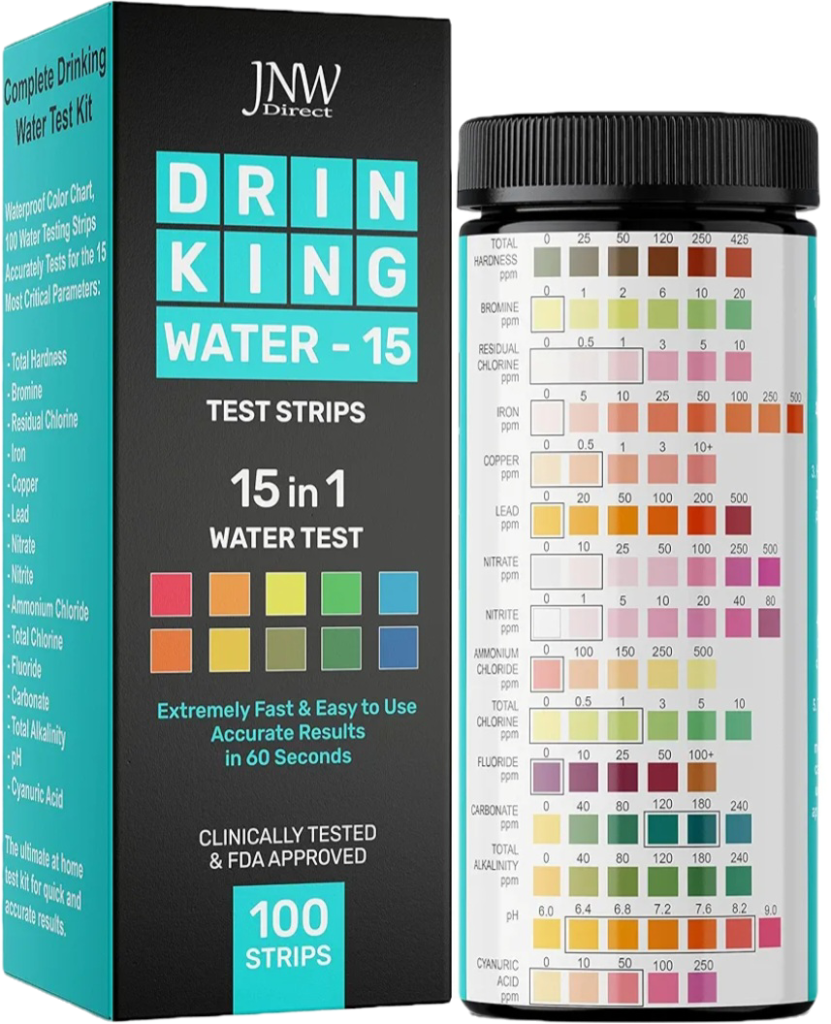
JNW Direct Water Hardness Test Kit 4.3/5 stars View on Amazon 150 test strips with eBook guide for testing water hardness specifically for coffee applications. Quick and accurate measurement of calcium and magnesium levels (0-425 ppm) to determine optimal descaling schedules.
ELESTAB 58mm Espresso Group Head Cleaning Brush 4.4/5 stars View on Amazon Professional 360-degree detachable brush with water deflection design to keep hands safe during cleaning. Features dual nylon bristles for cleaning group head and gaskets, plus built-in cleaning powder scoop.
Univen 58mm Backflush Insert 4.3/5 stars View on Amazon Stainless steel blind basket essential for proper espresso machine backflushing. Creates necessary pressure for effective cleaning solution circulation through internal pathways and group head cleaning.
Seasonal Deep Cleaning Protocol
Spring: Complete disassembly and professional inspection Summer: Focus on bacterial prevention during hot weather Fall: Prepare for increased usage during cold months Winter: Monitor for increased mineral buildup from dry air
Building Your Maintenance Routine
Creating Sustainable Habits
Start Small: Begin with daily basics, then gradually add weekly and monthly tasks
Set Reminders: Use phone alerts or calendar reminders for less frequent tasks
Batch Tasks: Combine weekly cleaning with other kitchen maintenance
Track Performance: Note taste improvements and brewing consistency
Maintenance Supplies Checklist
Essential Supplies:
Descaling solution (appropriate for your water hardness)
Espresso machine cleaner (if applicable)
Cleaning cloths (dedicated to coffee equipment)
Bottle brushes for narrow openings
Water test strips or TDS meter
Optional Upgrades:
Water filtration system
Professional cleaning brushes
Milk line cleaner
Grinder cleaning tablets
Monthly Maintenance Log
Track your cleaning schedule to ensure consistency:
Date: ___________ Tasks Completed: ___________ Water Hardness: ___________ Next Descaling Due: ___________ Performance Notes: ___________ Supplies Needed: ___________
Trust HydroBrewLab to Keep Your Drinks Just Right
Regular maintenance isn’t just about following a schedule—it’s about developing a relationship with your equipment that ensures every cup delivers the exceptional flavor you expect. The science is clear: clean machines brew better coffee, last longer, and save money over time.
We’ve tested these maintenance protocols in real-world conditions, working with coffee enthusiasts who demand the best from their equipment. Beyond surface-level hype, we focus on what really works: systematic care that transforms your daily brewing from routine maintenance into confident mastery.
Remember, every cleaning session is an investment in hundreds of future cups. With time, patience, and the comprehensive maintenance schedule in this guide, you’ll develop the intuition to keep your machine running perfectly while brewing consistently exceptional coffee.
Ready to master your maintenance routine? Start with daily basics, build weekly habits, and watch as your coffee quality improves dramatically. Before you know it, proper maintenance will become second nature—and every cup will remind you why the effort is worth it.
Bottom Line Up Front: That terrible espresso shot isn’t a lost cause—it’s your coffee beans telling you exactly what needs adjusting. Whether you’re dealing with sour, bitter, weak, or burnt flavors, the solution is usually just one simple tweak away. Master these troubleshooting techniques, and you’ll never have to suffer through another disappointing shot.
Even the most skilled baristas encounter issues from time to time. The good news is that every espresso problem has a solution, often with just a minor adjustment to your grind, dose, timing, or temperature. Here at HydroBrewLab, we’ve troubleshot countless espresso issues through real-world testing, and we’re here to guide you through fixing whatever’s gone wrong with your morning shot.
Pulling the perfect shot of espresso is a satisfying blend of science and art—but when things go wrong, it can feel more like chemistry gone bad. Don’t be afraid to experiment, because understanding what causes these flavor problems is the first step toward brewing consistently exceptional espresso.
Disclosure: As an Amazon Associate, HydroBrewLab earns from qualifying purchases. We only recommend products we’ve thoroughly tested and believe provide genuine value to our community. Your support helps us continue providing unbiased, data-driven reviews.
The Science Behind What You’re Tasting
Before diving into solutions, let’s understand what’s actually happening during extraction. When hot water hits your coffee grounds under pressure, it dissolves various compounds at different rates. Acids like chlorogenic acid extract first, followed by sugars and oils, and finally bitter compounds like tannic acid from the outer shell of the bean.
This extraction sequence explains why timing is so critical:
0-10 seconds: Primarily acids (sour flavors)
10-25 seconds: Balanced sweet and acidic compounds (ideal extraction window)
Sour shots indicate under-extraction—you’re stopping before the sugars and oils can balance the acids
Bitter shots signal over-extraction—you’ve pulled too many harsh compounds from the coffee
Weak shots suggest poor resistance, allowing water to rush through without proper extraction
Burnt shots typically result from excessive heat breaking down desirable compounds
Quick Visual Diagnosis Reference
Your espresso’s appearance tells a story before you even taste it:
Sour/Under-extracted Shots:
Gushes out in under 15 seconds
Pale yellow, thin liquid
Bubbly, rapidly dissipating crema
Dry, powdery puck after extraction
Bitter/Over-extracted Shots:
Slow pour taking 45+ seconds
Very dark brown, thick liquid
Dense, dark crema
Soggy puck with standing water
Weak Shots:
Fast pour with little resistance
Light color and thin body
Minimal crema formation
Loose, under-compressed puck
Burnt Shots:
Normal timing but harsh, charred taste
Often from temperature or bean issues
May show normal visual characteristics
The Sour Espresso Fix: When Your Shot Tastes Like Lemon
What’s happening: Under-extraction occurs when water runs through the coffee puck too quickly, meaning the delicious oils and sugars aren’t being extracted—only the acids that extract first.
The Complete Sour Fix Protocol
Step 1: Grind Finer (Primary Solution) Start here—this is your most powerful tool for fixing sour espresso. When your grind is too coarse, water flows through too quickly, preventing proper extraction of oils and sugars.
Adjust your grinder 1-2 clicks finer
Stick to around 0.8mm fine grinds for espresso
Test with small adjustments—too fine and you’ll swing into bitter territory
Look for a 25-30 second extraction time as your target
Step 2: Increase Your Coffee Dose More coffee creates more resistance, slowing down the water flow:
Add 1-2 grams more coffee to your portafilter
Standard starting point: 18-20 grams for a double shot
Maximum effective dose: Usually 22-24 grams before diminishing returns
Step 3: Perfect Your Distribution and Tamping Poor distribution is one of the biggest causes of channeling, which can create sour spots in your espresso. Even if your overall extraction is correct, channeling creates uneven flow.
Proper Distribution Technique:
Use the Weiss Distribution Technique (WDT) to break up clumps
Gently tap the portafilter sides 2-3 times to settle grounds
Level the surface before tamping
Tamping Essentials:
Apply 30 lbs of pressure consistently and keep the tamp perfectly level
Use your thumb and forefinger to gauge if the tamper is level with the basket rim
Start with 15 lbs pressure to form the initial puck, then increase to 30 lbs
Step 4: Check Water Temperature
Don’t let your water temperature fall under 197°F
Ideal range: 195-205°F (90-96°C)
Too cool and you won’t extract properly
For lighter roasts, aim for the higher end of this range
Step 5: Verify Your Coffee-to-Water Ratio
Target ratio: 1:2 (18g coffee to 36g liquid output)
Aim for 18 grams of coffee in, 36 grams of espresso out in 25-30 seconds
Adjust yield if timing is correct but flavors are still sour
Essential Grinders for Consistency
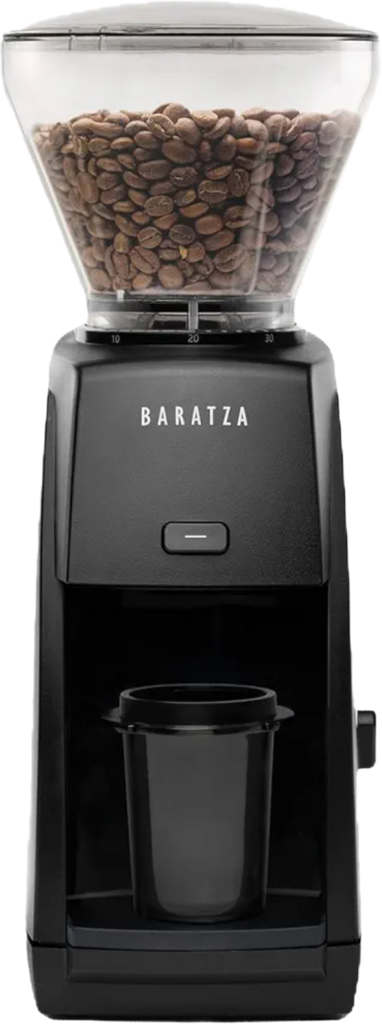
Baratza Encore ESP Coffee Grinder 4.4/5 stars View on Amazon Specifically designed for espresso with 40 grind settings and the M2 burr set that delivers exceptional uniformity. The simple interface makes micro-adjustments effortless for dialing in that perfect extraction.
OXO Brew Conical Burr Coffee Grinder 4.5/5 stars View on Amazon Great value option with 15 grind settings and a static-fighting container. The one-touch start timer and UV-blocking hopper make this perfect for home espresso enthusiasts.
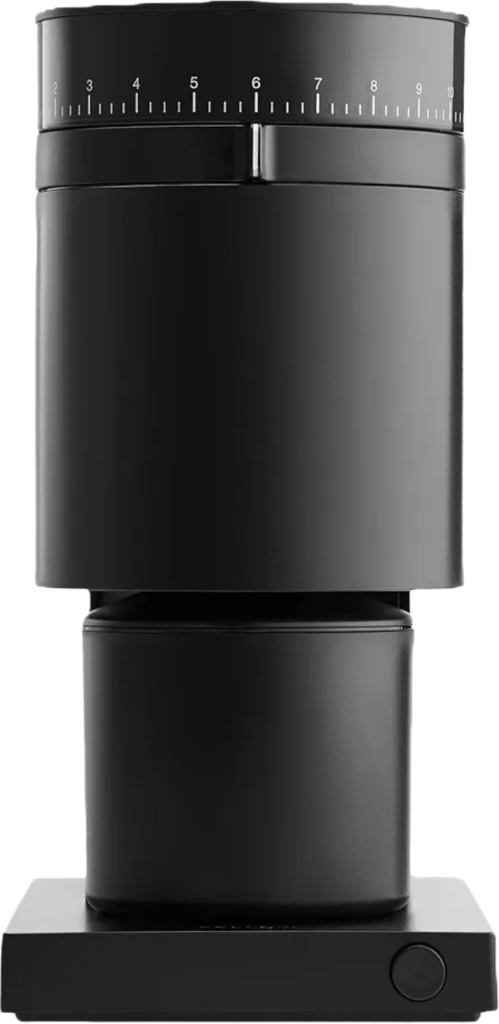
Fellow Opus Conical Burr Coffee Grinder 4.7/5 stars View on Amazon All-purpose electric grinder with 41 settings that excel from espresso to cold brew. The anti-static design and precise grinding make this a versatile workhorse for any coffee preparation method.
The Bitter Espresso Solution: Taming Harsh, Astringent Shots
What’s happening: Over-extraction occurs when water contacts the coffee grounds for too long or at too high a temperature, pulling out bitter compounds like tannic acid from the outer shell of the bean.
The Complete Bitter Fix Protocol
Step 1: Grind Coarser (Primary Solution) When your grind is too fine, water takes too long to pass through the grounds, resulting in over-extraction and bitter flavors.
Move to a coarser setting to speed up water flow
This reduces the density and contact time between water and coffee
Make small adjustments—dramatic changes can overcorrect
Target that 25-30 second extraction window
Step 2: Reduce Your Coffee Dose Sometimes less is more:
Try 1-2 grams less coffee
Less coffee = less resistance = faster extraction
Don’t go below 15 grams for a double shot
Monitor your yield to maintain proper ratios
Step 3: Master Extraction Timing Don’t brew espresso shots for longer than 45 seconds—this leads to high risk of tannic acid from coffee beans leaking into your drink.
Stop your shot before 45 seconds—ideally between 25-30 seconds
Watch for the “blonde” color change and stop immediately when you see it
This light-colored liquid is almost pure caffeine and adds harsh bitterness
If you want stronger coffee, use a larger basket rather than over-extracting
Step 4: Temperature Control
Ensure your water temperature stays under 205°F
Try 195-200°F for dark roasts
Use 200-205°F for lighter roasts
High temperatures extract bitter compounds more aggressively
Step 5: Equipment Maintenance Coffee residue and oil buildup makes espresso taste bitter. Regular cleaning is essential:
Run a cleaning cycle or backflush your machine weekly
Clean your portafilter and group head daily
Descale according to manufacturer recommendations
Replace water filters regularly
Professional Cleaning Arsenal
Urnex Cafiza Espresso Machine Cleaning Powder 4.6/5 stars View on Amazon Professional-grade cleaner that removes coffee oils and residue causing bitter flavors. NSF certified and safe for all espresso machines. Regular cleaning with Cafiza is crucial for maintaining consistent, clean-tasting espresso.
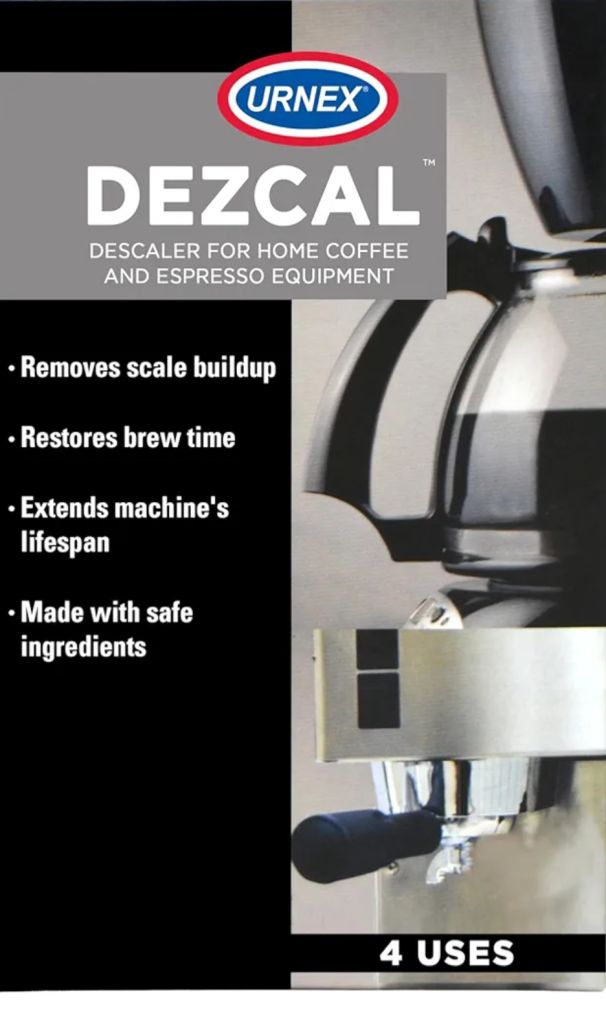
Dezcal Activated Scale Remover 4.5/5 stars View on Amazon Specifically formulated for espresso machine descaling. Removes mineral buildup that can affect temperature stability and water flow, both critical factors in preventing bitter over-extraction.
The Weak Espresso Revival: Building Body and Strength
What’s happening: Your shot lacks body, crema, and that rich espresso intensity you’re craving. This usually indicates insufficient resistance during extraction.
The Complete Weak Fix Protocol
Step 1: Increase Coffee Dose Strategically
Add 2-3 grams more coffee to your basket
More coffee = more flavor compounds to extract
Try 20-22 grams for a double shot
If you want stronger coffee, get a bigger basket (22g-28g) rather than over-extracting a smaller dose
Step 2: Fine-Tune Your Grind
Grind slightly finer to create more resistance
Slow down the pour to hit that 25-30 second extraction time
Monitor the flow—it should be steady like warm honey
Make incremental adjustments until you hit the sweet spot
Step 3: Upgrade Your Portafilter Basket Standard baskets often have irregularly spaced holes that cause uneven extraction:
VST or IMS precision baskets improve consistency
They create more uniform water distribution
Better extraction efficiency means more flavor from the same dose
Consider this upgrade if you’re serious about espresso quality
Step 4: Check Bean Freshness and Quality
Use coffee roasted 1-3 weeks ago for optimal extraction
Beans that are too fresh (under a week) can taste sour as they haven’t had time to degas
Stale beans (over a month) won’t extract properly
Store beans in airtight containers away from light and heat
Step 5: Verify Your Brewing Ratio
Target 1:2 ratio (18g coffee to 36g liquid)
For stronger espresso, try 1:1.5 ratio (18g to 27g liquid)
Adjust yield first, then timing if needed
Track your ratios for consistency
Precision Portafilter Tools
IMS Competition Series Precision Basket 4.8/5 stars View on Amazon These precision-holed baskets improve extraction consistency and shot quality. The uniformly spaced holes ensure even water distribution for balanced flavors and superior crema formation.
Normcore 58mm Precision Extraction Basket 5.0/5 stars View on Amazon Precision-engineered hole placement optimizes water flow and extraction efficiency. These professional-grade baskets feature uniform hole distribution that eliminates dead spots and improves overall shot consistency for home baristas.
The Burnt Flavor Fix: Cooling Down Harsh, Charred Notes
What’s happening: Either your water temperature is too high, your beans are over-roasted, or you’re extracting for too long, causing desirable compounds to break down.
The Complete Burnt Fix Protocol
Step 1: Temperature Management
Ensure your water temperature stays under 205°F
Try 195-200°F for dark roasts
Use 200-205°F for lighter roasts
Some machines run hot—verify with a thermometer if possible
Step 2: Bean Selection and Storage
Try different bean roasts because darker roasts naturally have a bitter flavor profile
Look for medium or medium-dark roasts instead of dark
Ensure beans aren’t over 21 days past roast date
Avoid beans with oil on the surface (sign of over-roasting or age)
Step 3: Milk Preparation (For Milk Drinks) Don’t scald your milk—keep steam temperatures between 155-165°F:
Scorched milk adds burnt flavors to your drink
Practice your steaming technique for silky microfoam
Use a thermometer until you develop muscle memory
Stop steaming before it gets too hot—milk continues cooking briefly
Step 4: Extraction Timing Review
Aim for 25-30 seconds maximum
Stop before blonde/light-colored liquid appears
Over-extracted shots taste burnt and harsh
If your timing is right but taste is still burnt, focus on temperature
Step 5: Water Quality Assessment Poor water quality can contribute to harsh, burnt flavors:
Use filtered water to avoid chlorine and mineral interference
Hard water with high bicarbonate levels can bring out bitter notes even in properly brewed coffee
Consider water specifically designed for espresso brewing
Change filters regularly
Temperature Control Tools
Maestri House Espresso Scale with Timer 4.5/5 stars View on Amazon Precise dosing and timing are crucial for consistent extractions. This professional-grade scale helps you nail your coffee-to-yield ratios and track extraction times for repeatable results that prevent over-extraction..
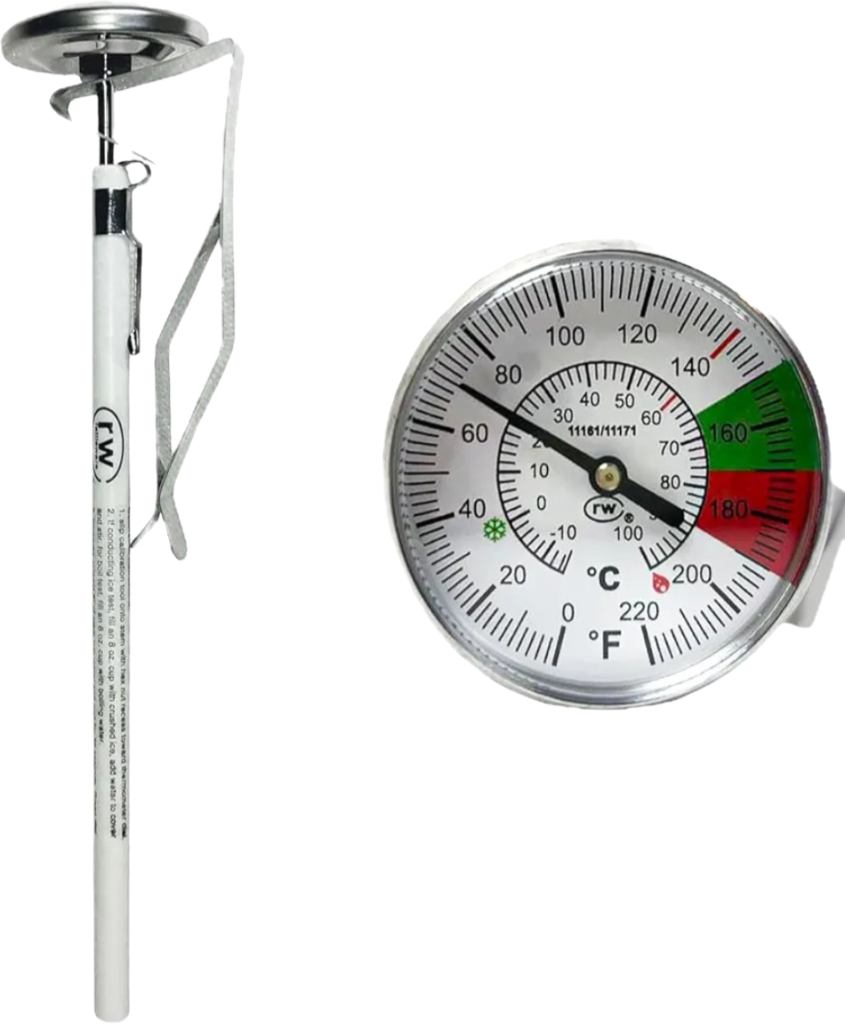
Rattleware Milk Frothing Thermometer 4.4/5 stars View on Amazon Perfect milk temperature is essential for avoiding burnt flavors in milk-based drinks. This clip-on thermometer ensures your milk stays in the optimal 150-160°F range for sweet, creamy texture.
Advanced Troubleshooting: When Basic Fixes Don’t Work
Understanding and Preventing Channeling
Channeling is when water finds weak spots or paths of least resistance through the coffee puck, causing uneven extraction. This creates a mixture of over-extracted (bitter) and under-extracted (sour) flavors in the same shot.
Signs of Channeling:
Uneven flow from the portafilter
Light “blonde” streaks in the espresso stream
Blonding at the beginning and throughout the shot duration
Inconsistent taste even with identical preparation
The Complete Anti-Channeling Strategy:
1. Master Distribution Techniques The Weiss Distribution Technique uses needles to stir ground coffee and break up clumps that can cause channeling:
Use a WDT tool with 0.4-0.7mm needles
Gently stir in figure-8 patterns
Work from edges toward center
Break up all visible clumps before tamping
2. Perfect Your Tamping The amount of pressure is not nearly as important as your consistency and ability to keep the tamp perfectly level:
Use consistent 30lb pressure
Keep tamper level using finger guides
Don’t twist or rotate during compression
Polish with gentle twist to smooth surface after main tamp
3. Check Your Grinder Performance Inconsistent grind size causes density variations that lead to channeling:
Clean burrs regularly to prevent static buildup
Calibrate grinder if you notice inconsistency
Consider upgrading if you have significant fines or boulders
Single-dose to ensure freshness and consistency
Professional Distribution Arsenal
Normcore Distribution Tool V4 4.7/5 stars View on Amazon Even coffee distribution prevents channeling and ensures uniform extraction. This adjustable tool creates a level bed of grounds for consistent water flow. The depth adjustment allows customization for different doses and basket types.
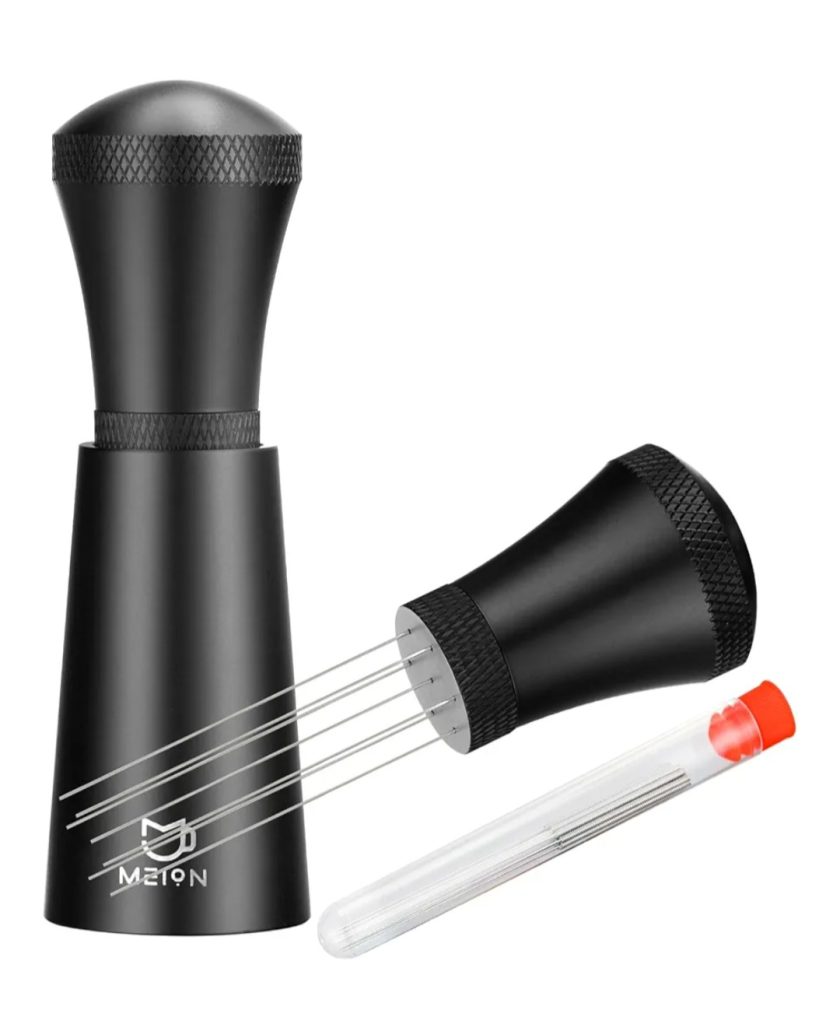
Meion Distribution Tool Espresso Stirrer 4.5/5 stars View on Amazon The Weiss Distribution Technique breaks up clumps and creates even distribution. This precision tool with 0.4mm needles helps eliminate channeling for more consistent shots. The ergonomic handle makes the technique comfortable and repeatable.
Advanced Grinder Calibration
Your grinder is arguably the most important piece of equipment for consistent espresso. Grind size may be the biggest factor that determines your espresso taste.
Calibration Best Practices:
Start with manufacturer’s baseline settings
Make single-click adjustments and test
Keep detailed notes of settings for different beans
Clean burrs weekly for consistent performance
Check for burr alignment if you notice asymmetric extraction
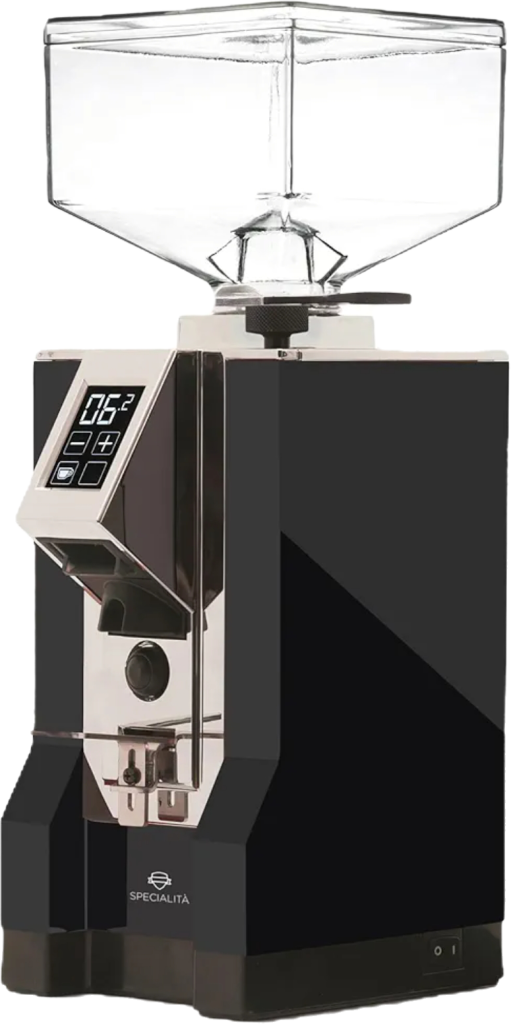
Eureka Mignon Specialita Espresso Grinder 4.7/5 stars View on Amazon Professional-grade stepless adjustment gives precise control over grind size. The 55mm flat burrs deliver exceptional consistency, and the low retention design means fresher shots every time. Hand-built in Italy with a reputation for durability.
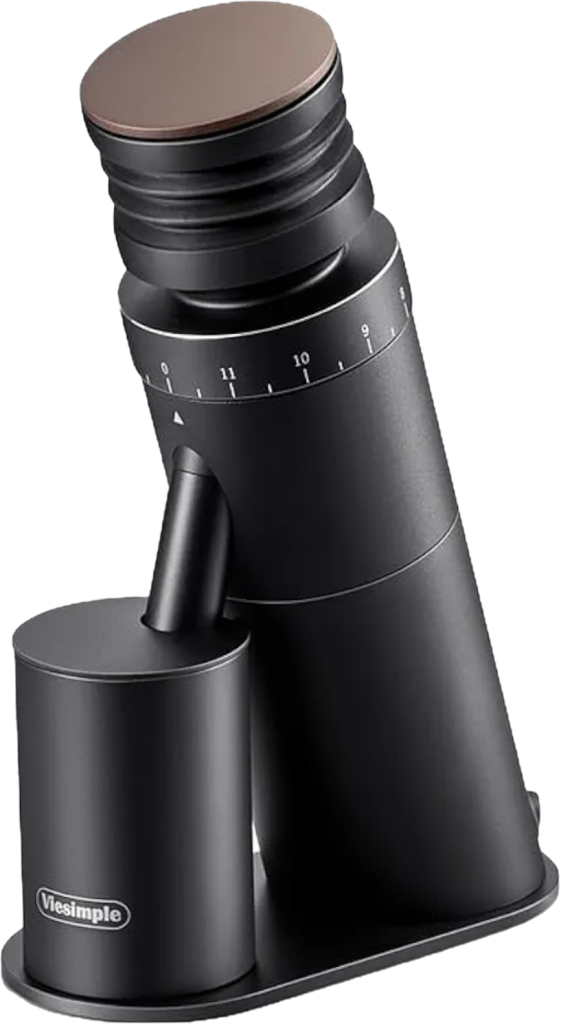
Viesimple Gen 4 Single Dose Grinder 4.6/5 stars View on Amazon True zero-retention grinding means every bean goes directly into your portafilter. The precision burr set produces exceptional uniformity with minimal static, making distribution easier and more consistent.
Water Quality Optimization
Water quality makes a significant difference in coffee flavor, and poor water can bring out bitter notes even in properly brewed coffee.
Ideal Water Specifications for Espresso:
Total Dissolved Solids (TDS): 150-300 ppm
Calcium: 50-175 ppm
Bicarbonate: 40-75 ppm
pH: 6.5-7.5
Chlorine: 0 ppm
Water Solutions:
Third Wave Water Espresso Profile 4.6/5 stars View on Amazon Mineral packets designed specifically for espresso brewing. Creates optimal water composition for extraction and flavor balance while protecting your equipment from scale buildup.
Mastering Your Espresso Recipe: The Complete Framework
The Universal Espresso Recipe for Perfect Shots
Start with these scientifically-proven baseline parameters, then adjust based on taste:
Base Recipe:
Coffee dose: 18-20 grams
Yield: 36-40 grams liquid espresso (1:2 ratio)
Time: 25-30 seconds
Water temperature: 200-203°F
Grind: Medium-fine (adjust based on results)
Advanced Ratio Adjustments:
Ristretto (concentrated): 1:1.5 ratio (18g to 27g)
Normale (balanced): 1:2 ratio (18g to 36g)
Lungo (extended): 1:2.5 ratio (18g to 45g)
The HydroBrewLab Diagnostic Tests
1. The Two-Cup Test Pull one espresso shot into two cups—first 15 seconds in one cup, remaining 15 seconds in another. The first cup should taste lovely, while the second will be full of bitter, sour, and burnt flavors. This clearly demonstrates how extraction changes throughout the shot.
2. The Consistency Challenge Pull five consecutive shots with identical parameters. If they taste different, focus on:
Distribution technique improvement
Tamping consistency
Dose accuracy
Grinder calibration
3. The Temperature Test Pull shots at 195°F, 200°F, and 205°F with all other variables constant. This helps you understand your machine’s optimal temperature for your preferred beans.
Professional Tamping Equipment
Proper tamping is crucial for consistent extraction. A great tamper needs proper weight, material, and fit—weight is incredibly important as you need 30 pounds of pressure to properly tamp espresso.
LuxHaus Calibrated Espresso Tamper 4.6/5 stars View on Amazon Calibrated to apply between 29-35 psi for each shot, this tamper takes the guesswork out of consistent pressure application. The ergonomic handle and spring-loaded mechanism ensure perfect tamps every time.
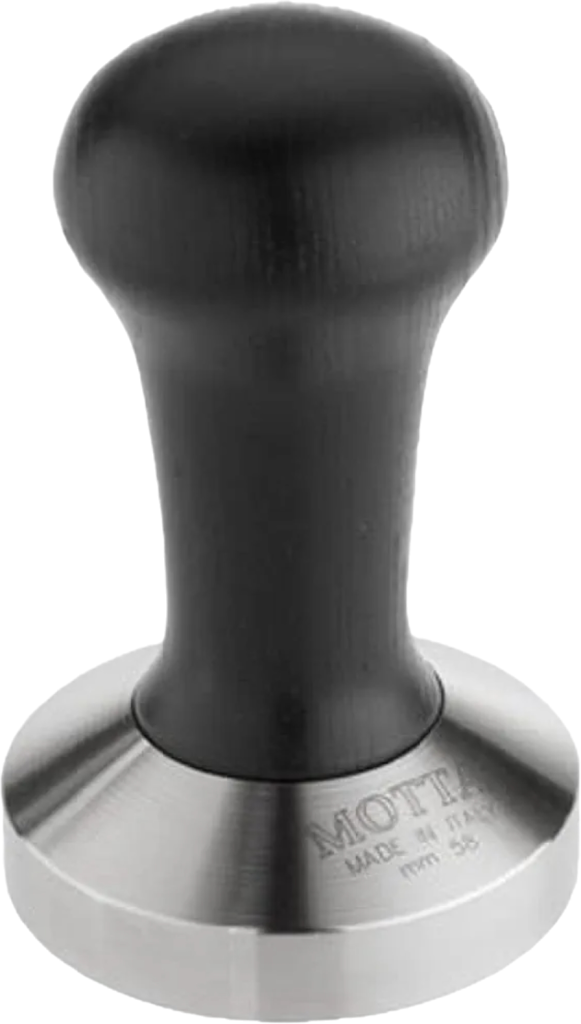
Motta Professional Tamper 4.7/5 stars View on Amazon Italian-made precision with a beautiful wooden handle and weighted stainless steel base. Simple yet expertly crafted design makes tamping effortless while providing professional-grade consistency.
Advanced Brewing Techniques
Pre-Infusion Optimization
Pre-infusion can dramatically improve extraction consistency and reduce channeling:
Benefits of Proper Pre-Infusion:
Allows coffee to bloom and expand evenly
Reduces pressure shock that can cause channeling
Improves overall extraction efficiency
Enhances flavor clarity and balance
Pre-Infusion Settings:
Duration: 3-8 seconds depending on dose and grind
Pressure: 2-4 bars (lower than full extraction pressure)
Visual cue: Wait for first drops to appear before full pressure
Pressure Profiling for Flavor Control
If your machine allows pressure adjustment, experiment with these profiles:
For Bright, Acidic Coffees:
Start at 6 bars, ramp to 9 bars over 10 seconds
Finish at 7 bars for the last 10 seconds
Emphasizes clarity and brightness
For Dark, Chocolatey Coffees:
Start at 9 bars immediately
Drop to 6 bars after 15 seconds
Reduces bitter extraction while maintaining body
Your Complete Espresso Troubleshooting Toolkit
The Daily Troubleshooting Checklist
For Sour Espresso:
✓ Grind finer by 1-2 clicks
✓ Increase dose by 1-2g
✓ Check water temperature (197°F minimum)
✓ Verify distribution technique
✓ Ensure level tamping
For Bitter Espresso:
✓ Grind coarser by 1-2 clicks
✓ Reduce dose by 1-2g
✓ Stop shot by 30 seconds maximum
✓ Lower water temperature by 2-3°F
✓ Clean machine and portafilter
For Weak Espresso:
✓ Increase dose by 2-3g
✓ Grind slightly finer
✓ Consider larger/precision basket
✓ Check bean freshness (1-3 weeks old)
✓ Verify brewing ratio (1:2 standard)
For Burnt Espresso:
✓ Lower water temperature below 205°F
✓ Try medium roast instead of dark
✓ Reduce extraction time if over 30 seconds
✓ Check milk steaming temperature (155-165°F)
✓ Assess water quality and filtration
Weekly Maintenance Protocol
Equipment Care:
Deep clean portafilter and group head
Backflush with cleaning powder
Descale according to water hardness
Clean and calibrate grinder
Replace water filter if needed
Bean Management:
Check roast dates and rotate stock
Store in airtight containers
Avoid pre-grinding for extended periods
Note flavor changes as beans age
Beyond the Basics: Professional Tips
Reading Your Espresso Like a Pro
Crema Analysis:
Thick, golden crema: Good extraction and fresh beans
Thin, pale crema: Under-extraction or stale beans
Dark, thin crema: Over-extraction or over-roasted beans
Bubbly, rapidly dissipating: Poor distribution or stale coffee
Flow Pattern Recognition:
Steady, honey-like flow: Ideal extraction
Fast gushing: Too coarse or under-dosed
Slow dripping: Too fine or over-dosed
Uneven streams: Channeling from poor distribution
Building Your Palate
Daily Cupping Practice:
Taste espresso neat before adding milk
Note flavor changes as temperature drops
Compare single-origin vs. blend characteristics
Document preferences and successful parameters
Flavor Wheel Training:
Learn to identify specific flavor notes
Practice distinguishing between bitter and sour
Understand how processing affects taste
Connect flavors to extraction parameters
Master the Perfect Sip
Espresso troubleshooting is part of the learning curve—and even seasoned baristas still tweak their technique. The secret lies in making small, methodical adjustments and understanding that each variable affects the others. With time, patience, and the comprehensive techniques in this guide, you’ll develop the intuition to diagnose and fix any espresso issue that comes your way.
Remember, every “terrible” shot is actually valuable feedback from your setup. The science is solid, the techniques are proven, and the tools are available—now it’s time to put it all together. Don’t be afraid to experiment, take detailed notes, and most importantly, taste everything. That perfect espresso shot is waiting for you—it just needs the right combination of grind, dose, time, temperature, and technique to unlock its potential.
We test, we compare, we care, and most of all, we listen to the community. These troubleshooting methods are battle-tested in cafes and home kitchens worldwide. Beyond surface-level hype, we focus on what really works: systematic problem-solving that gets you from frustrated to fantastic, one shot at a time.
Ready to level up your espresso game? Start with one adjustment at a time, taste the difference, and build your palate. Before you know it, you’ll be pulling shots that rival your favorite coffee shop—right from your own kitchen. Trust HydroBrewLab to keep your drinks just right, and remember: every expert was once a beginner who refused to give up on the perfect cup.
Even the most vigilant households can face an invisible threat flowing silently from their taps—heavy metals that accumulate in the body over time, causing health impacts that may not surface for years. Lead, mercury, and arsenic represent some of the most dangerous contaminants in modern water supplies, entering through aging infrastructure, industrial activities, and natural geological processes.
Here at HydroBrewLab, we test, we compare, we care, and most of all, we listen to the community about what really works for protecting families from these persistent toxins. Understanding the sources, health risks, and most effective removal methods can mean the difference between confident daily hydration and long-term health consequences.
Bottom Line Up Front: Heavy metals pose serious health risks even at low concentrations, particularly for children and pregnant women. Reverse osmosis systems provide the most comprehensive removal (up to 99%), while specialized ion exchange and KDF filtration offer targeted solutions. Regular testing is essential since heavy metals are often undetectable by taste, smell, or appearance.
Disclosure: As an Amazon Associate, HydroBrewLab earns from qualifying purchases. We only recommend products we’ve thoroughly tested and believe provide genuine value to our community. Your support helps us continue providing unbiased, data-driven reviews.
Understanding Heavy Metal Contamination: The Invisible Threat
Heavy metals are naturally occurring elements that have a high atomic weight and a density at least five times greater than that of water. While some heavy metals are essential for human health in trace amounts, others can be toxic. The most concerning heavy metals in drinking water include lead, arsenic, mercury, and cadmium.
The Scale of the Problem
According to the U.S. Environmental Protection Agency, heavy metals are among the priority pollutants that are of public health significance. These metallic elements are considered systemic toxicants that are known to induce multiple organ damage, even at lower levels of exposure. They are also classified as human carcinogens (known or probable) according to international health organizations.
More than 30 nations have concluded that arsenic, cadmium, chromium and mercury in water are detrimental to public health. The widespread occurrence of heavy metals in the environment is mainly due to human activities such as industry, agriculture, mining, and improper waste disposal, which have resulted in the build-up of harmful heavy metals in ecosystems.
Why Heavy Metals Are Particularly Dangerous
Unlike organic contaminants that can be broken down over time, heavy metals are non-biodegradable and persist indefinitely in the environment. Their toxicity is often exacerbated by their ability to bioaccumulate and biomagnify in food chains.
Heavy metals have been reported to affect cellular organelles and components such as cell membrane, mitochondrial, lysosome, endoplasmic reticulum, nuclei, and some enzymes involved in metabolism, detoxification, and damage repair. Metal ions have been found to interact with cell components such as DNA and nuclear proteins, causing DNA damage and conformational changes that may lead to cell cycle modulation, carcinogenesis or apoptosis.
The Big Three: Lead, Mercury, and Arsenic
Lead: The Silent Neurotoxin
Sources of Contamination: Lead enters drinking water primarily through the corrosion of pipes and plumbing fixtures. Aging infrastructure in many U.S. cities still contains lead service lines, while older homes may have lead solder joints and fixtures. The U.S. Environmental Protection Agency has set the maximum contaminant level goal for lead in drinking water at zero, recognizing that there is no safe level of lead exposure.
Health Impacts: Lead exposure is particularly damaging to the nervous system, leading to cognitive impairments, developmental delays in children, and neurological disorders in adults. High levels of lead can cause coma, convulsion or death. Children are especially vulnerable because lead can interfere with brain and physical development even at minute concentrations.
Lead exposure in children has been linked to:
Reduced IQ and learning disabilities
Behavioral problems and ADHD
Delayed growth and development
Hearing problems
Anemia
Detection Challenges: Lead contamination is particularly insidious because it’s completely undetectable by taste, smell, or appearance. Water can look crystal clear while containing dangerous levels of this neurotoxin.
Mercury: The Brain and Kidney Destroyer
Sources of Contamination: Mercury is released into the environment from various industrial activities, including coal-fired power plants and mining operations. It can accumulate in water bodies and enter the drinking water supply through atmospheric deposition and industrial discharge.
Health Impacts: Mercury exposure can adversely affect the nervous system and is particularly harmful to developing fetuses. The EPA’s maximum contaminant level for mercury in drinking water is set at 2 ppb, but even at these low levels, chronic exposure raises concerns.
Mercury toxicity can cause:
Neurological and behavioral disorders
Cognitive impairments and motor dysfunctions
Kidney and liver damage
Reproductive problems and birth defects
Immune system suppression
Special Vulnerability: Pregnant women and young children are particularly vulnerable to mercury’s toxic effects. Mercury can easily cross the placenta, particularly during early gestation, leading to spontaneous abortion, stillbirth, preterm birth, and low birth weight.
Arsenic: The “King of Poisons”
Sources of Contamination: Arsenic is naturally present in rocks and soil and can seep into groundwater sources. Regions with high natural arsenic deposits face significant challenges in maintaining safe water supplies. It is also used in agricultural applications, such as pesticides, which can contribute to its presence in water supplies.
Health Impacts: The EPA has established a maximum contaminant level of 10 parts per billion (ppb) for arsenic in drinking water. However, even at levels below this standard, there are concerns about long-term health effects. Arsenic is notoriously known as the “king of poisons” due to its severe toxicity.
Long-term exposure to arsenic in drinking water is associated with:
Increased risk of cancer (lung, liver, bladder, kidneys)
Skin lesions and skin cancer
Cardiovascular diseases
Diabetes and metabolic disorders
Respiratory difficulties
Cumulative Effects: Drinking 1 L of water with 50 μg/L arsenic per day is linked to serious health complications. Arsenic concentrations of 0.0012 mg/kg/day can result in serious skin damage and respiratory difficulties, with effects accumulating over time.
Weathering of rocks is a primary natural source of metals such as nickel and arsenic. Over time, water dissolves these metals, which leach into nearby water sources. This natural leaching process can be exacerbated by climatic conditions.
Natural processes contributing to heavy metal contamination include:
Geological weathering – Gradual breakdown of metal-containing rocks and minerals
Volcanic activity – Releases various metals into the atmosphere and water systems
Atmospheric deposition – Metals transported over large distances through rain and dust
Natural mineral deposits – Concentrated metal sources that can contaminate groundwater
Human Activities
Human activities significantly amplify the concentration of heavy metals beyond natural levels. Industries discharge various metals through waste streams, with manufacturing and metal processing being notable contributors.
Major anthropogenic sources include:
Industrial discharges – Mining, smelting, manufacturing, and chemical production
Agricultural runoff – Pesticides, fertilizers, and animal manures containing metals
Urban development – Increased impervious surfaces leading to contaminated stormwater runoff
Aging infrastructure – Corroding pipes, fixtures, and distribution systems
Lead contamination is especially concerning due to its common presence in older plumbing systems. Many homes built before 1986 contain lead pipes, solder, or fixtures that can leach lead into drinking water. This issue is further aggravated when water chemistry changes occur, such as switching water sources or treatment methods.
The Most Effective Heavy Metal Removal Methods
Not all water treatment technologies are created equal when it comes to heavy metal removal. Understanding the science behind each method helps you choose systems that actually work rather than those that simply claim to work.
Reverse Osmosis: The Gold Standard
Reverse osmosis represents the most comprehensive and effective method for heavy metal removal available to homeowners. RO systems can eliminate up to 99% of heavy metals present in water, ensuring exceptional water quality.
How It Works: Reverse osmosis uses added pressure to push water through a semipermeable membrane with pores so small (0.0001 micrometers) that only pure water molecules can pass through. Heavy metals, which are much larger than water molecules, are physically blocked and flushed away in the reject water.
Removal Effectiveness:
Lead removal: Up to 99% reduction
Mercury removal: 95-99% reduction
Arsenic removal: 95-99% reduction for both arsenate (As V) and arsenite (As III)
Cadmium removal: 99.4% removal efficiency
Chromium removal: 95-98% reduction
Technical Advantages: RO removal efficiencies are high for metals, with upwards of 99.4% removal for metals like cadmium and copper. The molecular size of the solutes blocked is usually in the range of 0.00025–0.003 μm, making RO extremely effective against dissolved heavy metals.
Considerations: While highly effective, RO systems are more expensive (systems cost anywhere from $150-$1000) and create a high volume of wastewater. The process typically produces 2-4 gallons of reject water for every gallon of purified water produced.
Ion Exchange: Targeted Metal Removal
Ion exchange technology offers a highly effective alternative for heavy metal removal, particularly excelling at removing specific metal ions from water.
How It Works: When water passes through an ion exchange resin, heavy metal ions are attracted to the resin surface and easily swap places with harmless ions like chloride, making the discharge water safe to drink and use. The resin beads contain positively charged functional groups that attract and hold negatively charged heavy metal ions.
Removal Effectiveness: Ion exchange can reduce nickel, mercury, lead, cadmium, chromium, and copper in water with removal rates often exceeding 90% for target metals. The technology is highly effective for both long and short-chain heavy metals and is less affected by competing organic matter than activated carbon.
Technical Advantages:
Regenerable technology – Resins can be cleaned and reused multiple times
Selective removal – Can target specific metals based on resin chemistry
High capacity – Can process large volumes before requiring regeneration
pH tolerance – Works across a wider pH range than some alternatives
Limitations: Ion exchange systems require diligent cleaning through backwash and brine regeneration, cannot handle highly concentrated metal solutions, and are not selective to heavy metals (they also remove beneficial minerals).
KDF (Kinetic Degradation Fluxion) Media: Chemical Reduction
KDF media uses a copper-zinc alloy to remove heavy metals through a process called redox (reduction-oxidation).
How It Works: As water flows through KDF media, electrons are transferred between the dissimilar metals, creating an electrochemical reaction that converts dissolved metal ions into harmless metallic particles that can then be filtered out.
Removal Effectiveness:
Lead reduction: 95-98% effectiveness
Mercury reduction: 95% or greater
Copper reduction: Highly effective due to electrochemical affinity
Iron and hydrogen sulfide: Excellent removal rates
Technical Advantages: KDF media works particularly well in combination with activated carbon, providing both heavy metal removal and chlorine reduction. The media also has antimicrobial properties that prevent bacterial growth within the filter system.
Activated Carbon: Limited but Important Role
While activated carbon filters excel at removing chlorine, volatile organic compounds, and some chemicals, their effectiveness against dissolved heavy metals is limited.
How It Works: Activated carbon removes contaminants through adsorption, where pollutants stick to the surface of the carbon. Chemical activation using agents like phosphoric acid or zinc chloride makes the carbon more porous, increasing its ability to trap some metal ions.
Removal Effectiveness: Standard activated carbon filters are generally ineffective at removing dissolved metals from drinking water. However, specially designed carbon filters with enhanced surface chemistry can remove some heavy metals like copper and lead, though not as effectively as RO or ion exchange.
Best Applications: Activated carbon works best as a pre-filter in multi-stage systems, removing chlorine that could damage RO membranes and improving taste and odor while other technologies handle heavy metal removal.
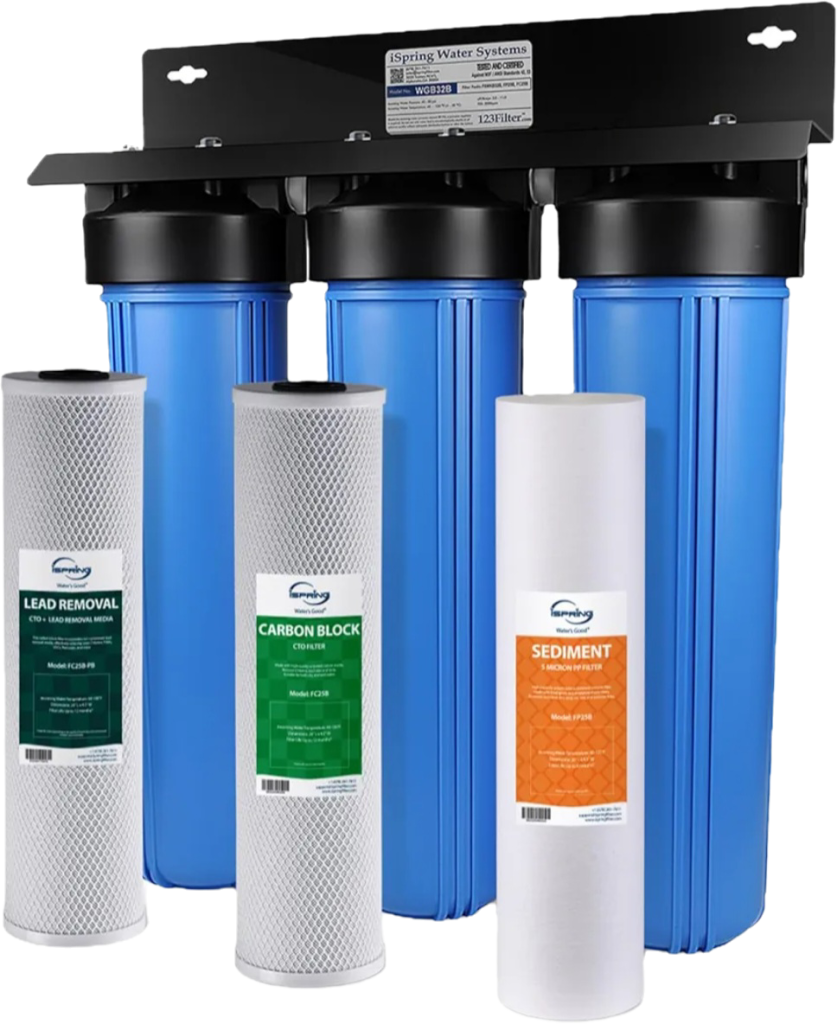
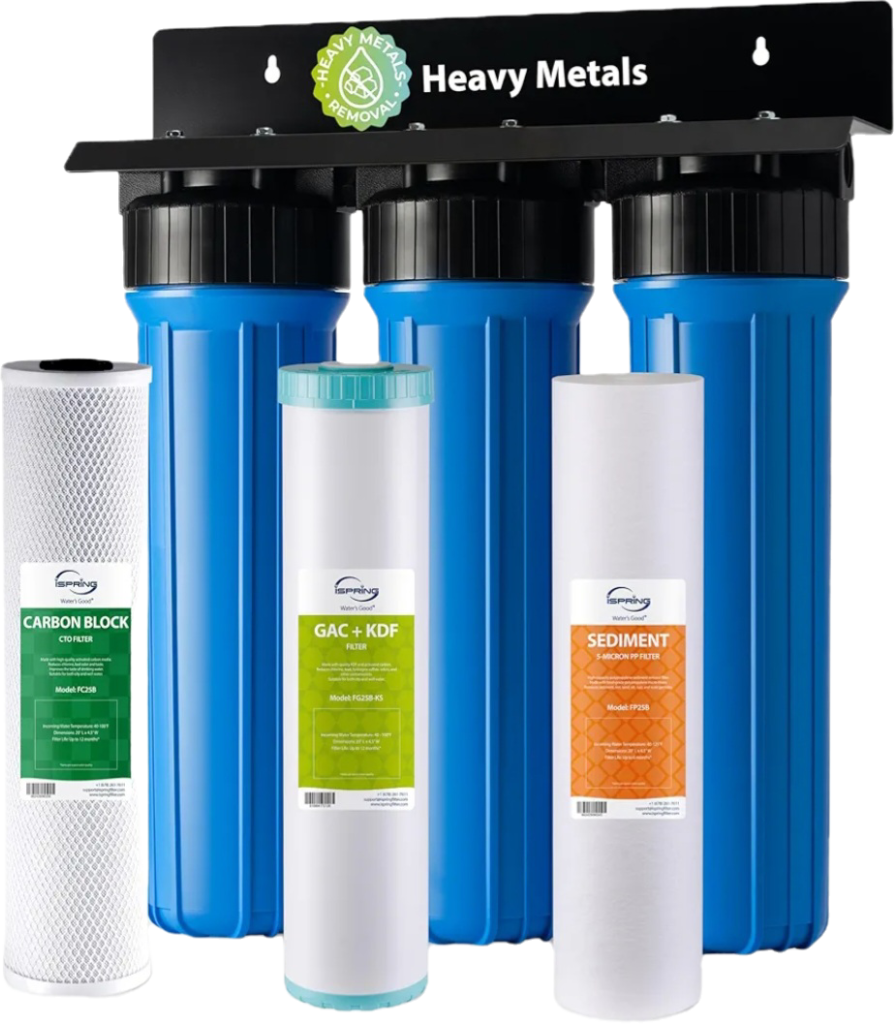
The iSpring WGB32B-CPB stands as the gold standard for comprehensive whole-house heavy metal protection, combining three specialized filtration stages to address the full spectrum of metal contamination. This SGS-tested system effectively removes up to 99% of lead from your water, ensuring safer drinking water for your entire household.
Why It Works: The system employs advanced MetSorb media in the third stage, specifically designed to target heavy metals through specialized adsorption mechanisms. The FC25B-PB filter has been rigorously tested by SGS laboratory, providing verified performance data rather than theoretical claims. This multi-stage approach ensures that different types of contamination are addressed by the most appropriate technology.
Key Features:
SGS-tested lead removal – Verified 99% lead reduction with laboratory documentation
Comprehensive heavy metal filtration – Removes arsenic (III & V), mercury, cadmium, and chromium
Advanced MetSorb media – Superior filtration that extends filter lifespan
High-performance sediment filtration – 5-micron PP filter captures particles and protects downstream media
100,000-gallon capacity – Suitable for family of four with approximately one year service life
1-inch inlet/outlet ports – Accommodates high flow rates for whole-house applications
Real-World Performance: During independent testing, the system maintained consistent heavy metal removal even as source water quality fluctuated. The three-stage design provides redundancy—if one stage becomes less effective, the others continue protecting your water supply. Users report noticeable improvements in water quality, taste, and reduced staining on fixtures.
Technical Advantage: Unlike single-media systems, the WGB32B-CPB uses specialized media for each contamination type. The MetSorb technology specifically targets arsenic and other heavy metals through enhanced surface chemistry, while the lead-removal media utilizes proven ion exchange mechanisms for maximum effectiveness.
Practical Benefits: Easy to install and maintain with clear housing designs that allow visual filter monitoring. U.S.-based customer service and extended warranties provide long-term support. The system protects not just drinking water but all household water uses, extending appliance life and improving overall water quality.
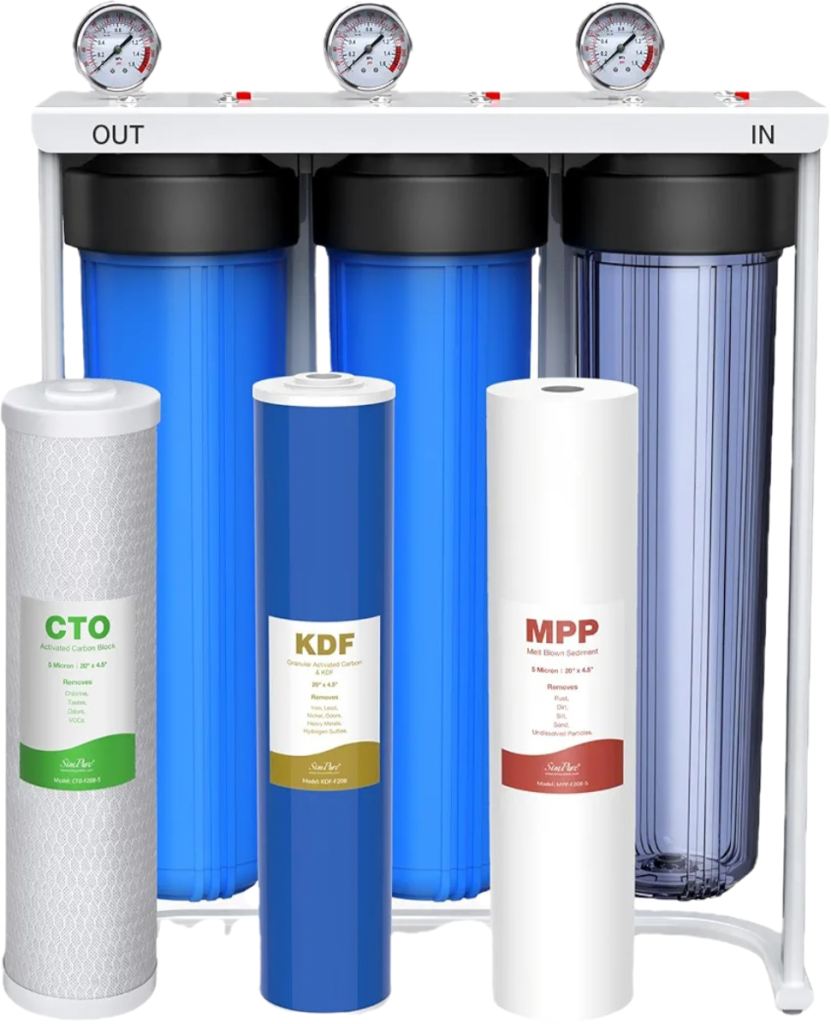
SimPure DB20P-3KDF 3-Stage Whole House Heavy Metal System
The SimPure DB20P-3KDF delivers professional-grade heavy metal removal through innovative KDF (Kinetic Degradation Fluxion) technology combined with high-capacity carbon filtration. This system specifically targets heavy metal contamination while providing comprehensive water treatment for the entire household.
Why It Works: The system utilizes KDF-55 media, a high-purity copper-zinc alloy that removes heavy metals through redox reactions. As water flows through the KDF media, electrons are transferred between metals, converting dissolved metal ions into harmless particles that are then filtered out. This electrochemical process is particularly effective against lead, mercury, and copper.
Key Features:
KDF-55 heavy metal media – Copper-zinc alloy provides electrochemical heavy metal removal
20-inch filter cartridges – Large capacity reduces replacement frequency
3-stage filtration process – Sediment, KDF, and carbon for comprehensive treatment
Clear filter housings – Visual monitoring of filter condition and replacement timing
4.5-inch diameter cartridges – High flow rate capability for whole-house applications
NSF-certified components – Quality assurance for safety and performance standards
Real-World Performance: The KDF media provides consistent heavy metal removal while also offering antimicrobial benefits that prevent bacterial growth within the system. Users report significant improvements in water taste, reduced metallic flavors, and protection for water-using appliances throughout the home.
Technical Advantage: KDF technology offers unique advantages over traditional filtration media. The electrochemical process continues working even as the media becomes loaded with contaminants, providing more consistent performance throughout the filter life. The antimicrobial properties prevent biofilm formation that can compromise other filtration systems.
Practical Benefits: The three-stage design allows targeted replacement of individual filters based on water conditions, reducing long-term operating costs. Clear housings enable easy monitoring, while the robust construction handles varying water pressures and flow demands typical in whole-house applications.
Under-Sink Systems
SimPure T1-400UV 8-Stage Tankless Reverse Osmosis System
The SimPure T1-400UV represents the pinnacle of tankless reverse osmosis technology, combining 8 specialized filtration stages with UV sterilization to eliminate over 99.99% of harmful contaminants including heavy metals, viruses, bacteria, PFAS chemicals, and more. This NSF/ANSI 58 certified system delivers pure water with TDS levels near 0 PPM while maintaining exceptional flow rates.
Why It Works: The 8-stage process employs multiple filtration technologies in sequence, with the RO membrane serving as the primary heavy metal barrier and UV sterilization providing additional pathogen protection. The tankless design eliminates bacterial growth concerns while the SGS-tested performance ensures verified contaminant removal rather than theoretical claims.
Key Features:
SGS-tested 99.99% contaminant removal – Verified removal of heavy metals (lead, arsenic, mercury), PFAS, TDS, and 1,000+ contaminants
Real-World Performance: User testing shows the system reduces city water from 270 PPM TDS to 0 PPM for the first 6 months, then maintaining steady 10-14 PPM levels after 1.5 years of operation. The RO membrane removes contaminants 0.0001 microns or greater in diameter, including metal ions, heavy metals, and dissolved solids while allowing only water molecules to pass through.
Technical Advantage: The 8-stage design optimizes each filtration step for maximum effectiveness while the UV sterilization provides an additional safety barrier against pathogens that might survive other treatment methods. The tankless design eliminates the bacterial growth risk associated with storage tanks while providing immediate access to filtered water.
Practical Benefits: The system includes twist-in filter design for tool-free 3-second cartridge replacement, filter replacement alerts, and the ability to connect to refrigerators with an optional pressure tank. Professional installation support and comprehensive warranty coverage ensure long-term reliability and performance.
The APEC ROES-50 has earned recognition as one of the most reliable and effective heavy metal removal systems available for residential use. This 5-stage reverse osmosis system delivers consistent, high-quality water while removing up to 99% of contaminants including heavy metals, TDS, bacteria, viruses, and fluoride.
Why It Works: APEC’s proprietary membrane technology combined with high-quality pre and post-filters creates a comprehensive barrier against heavy metal contamination. The system uses a high-rejection RO membrane specifically selected for its heavy metal removal capabilities, while the multi-stage pre-filtration protects membrane integrity and extends system life.
Key Features:
High-rejection RO membrane – Superior heavy metal removal with 99% effectiveness
NSF-certified components – All filters meet strict quality and safety standards
50-gallon daily capacity – Adequate production for most household needs
Automatic shut-off valve – Prevents system overpressure and water waste
Quick-connect fittings – Reliable connections that prevent leaks
3.2-gallon pressurized tank – Ensures consistent water availability
Premium filter media – High-quality carbon and sediment filters for optimal performance
Real-World Performance: The ROES-50 consistently delivers water with heavy metal levels below detection limits. The robust construction and quality components result in excellent long-term reliability, with many systems operating effectively for years with only routine filter changes.
Technical Advantage: APEC’s focus on premium components results in superior performance and reliability compared to budget alternatives. The high-rejection membrane specifically targets heavy metals while maintaining reasonable flow rates, and the quality pre-filtration significantly extends membrane life.
Practical Benefits: The system includes everything needed for installation, with clear instructions and reliable customer support. The automatic shut-off prevents overpressurization, while the pressurized tank ensures immediate water availability without waiting for the system to produce water.
The Clearly Filtered pitcher represents the most advanced countertop solution for heavy metal removal, utilizing patented Affinity filtration technology to remove up to 99.5% of heavy metals while retaining beneficial minerals. This NSF-tested system provides laboratory-grade filtration in a convenient, portable format.
Why It Works: The pitcher employs Affinity filtration technology that specifically targets contaminants based on molecular size and charge. This selective approach removes harmful heavy metals while allowing beneficial minerals like calcium and magnesium to pass through, maintaining water’s natural mineral balance and taste.
Key Features:
NSF-tested heavy metal removal – 99.5% reduction of lead, mercury, and arsenic
10-cup capacity – Large volume reduces refill frequency
Long-lasting filters – Each filter lasts 100 gallons or approximately 4 months
BPA-free construction – Safe, food-grade materials throughout
No installation required – Immediate use with simple setup
Real-World Performance: Independent testing confirms the pitcher’s ability to reduce heavy metals to levels well below EPA standards while maintaining excellent taste. The filter’s longevity and consistent performance make this a cost-effective option for households seeking portable heavy metal protection.
Technical Advantage: Unlike traditional carbon filters that rely primarily on adsorption, the Affinity technology uses multiple removal mechanisms including ion exchange and specialized binding sites. This multi-modal approach ensures effective removal across a broad range of heavy metal types and concentrations.
Practical Benefits: The pitcher provides filtered water immediately without installation or plumbing modifications. The large capacity and long filter life minimize maintenance requirements, while the mineral retention ensures water tastes natural and refreshing rather than flat or over-processed.
Testing for Heavy Metals: Know Before You Treat
Before investing in filtration systems, understanding your specific heavy metal contamination levels helps choose appropriate treatment strategies and verify system effectiveness.
When to Test
Regular testing becomes essential in several scenarios:
Private well owners – Annual testing recommended, especially after heavy rains or nearby industrial activity
Homes built before 1986 – Lead testing crucial due to potential lead pipes and solder
Areas with known contamination – Mining regions, industrial zones, or areas with contaminated groundwater
Unexplained health symptoms – Neurological issues, developmental concerns, or chronic fatigue
Water taste or appearance changes – Metallic taste, discoloration, or unusual odors
Professional Laboratory Testing
Laboratory analysis provides the most accurate assessment of heavy metal contamination levels. Search you local area for water testing or call your local health department.
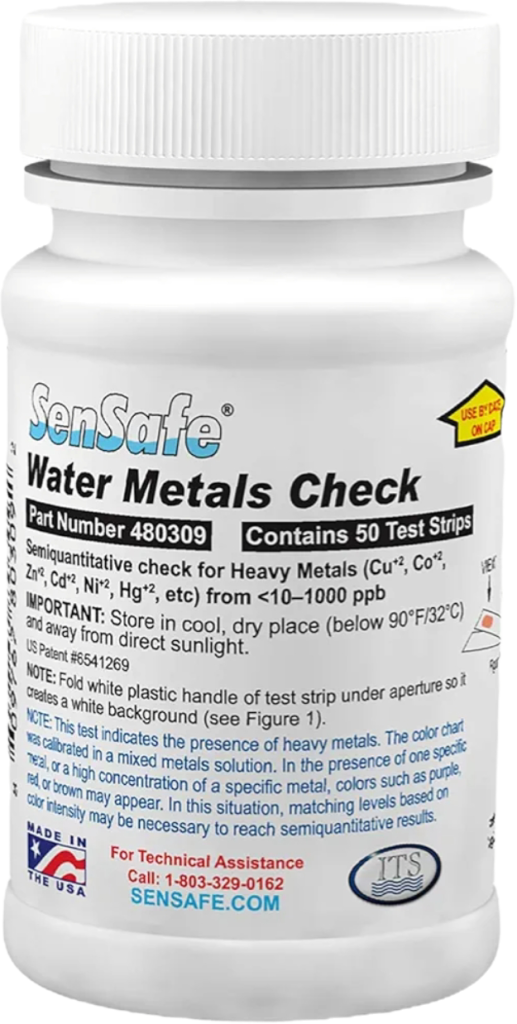
Rapid screening test for multiple heavy metals including lead, mercury, and arsenic. Provides semi-quantitative results in minutes, ideal for initial screening before laboratory confirmation.
Health Protection Strategies
Immediate Actions for High-Risk Households
If testing reveals heavy metal contamination or if you’re in a high-risk category, immediate protective measures can reduce exposure while permanent solutions are implemented.
High-Risk Categories:
Pregnant women and nursing mothers
Children under 6 years old
Individuals with compromised immune systems
Residents of homes built before 1986
Well water users in mining or industrial areas
Immediate Protection Steps:
Use bottled water for drinking and cooking until filtration is installed
Run cold water for 30 seconds before use to flush standing water from pipes
Use only cold water for cooking and drinking, as hot water leaches more metals
Remove lead sources like old paint, ceramic glazes, and crystal glassware
Install point-of-use filtration at kitchen tap as temporary protection
Long-Term Health Monitoring
Regular health monitoring helps detect early signs of heavy metal exposure and assess the effectiveness of protective measures.
Key Health Indicators:
Blood lead levels (especially important for children)
Neurological development and cognitive function
Kidney and liver function tests
Cardiovascular health markers
Immune system function
Maintenance and System Optimization
Effective heavy metal removal requires proper system maintenance and periodic verification of performance.
Filter Replacement Schedules
Different filtration technologies require specific maintenance schedules to ensure continued effectiveness:
Reverse Osmosis Systems:
Pre-filters: Every 6-12 months
RO membrane: Every 2-3 years
Post-filters: Every 12 months
Ion Exchange Systems:
Monitor TDS levels as indicator of resin exhaustion
Regenerate resins according to manufacturer specifications
Replace resins every 3-5 years depending on usage
KDF and Carbon Systems:
Replace every 6-12 months or according to capacity ratings
Monitor pressure drop as indicator of loading
Consider more frequent replacement in high-contamination areas
Performance Verification
Regular testing ensures your filtration system continues protecting your family:
Testing Schedule:
Initial verification: Test before and after installation
Routine monitoring: Annual testing or as recommended by manufacturer
Filter change verification: Test after major filter replacements
Problem investigation: Test if taste, odor, or flow changes occur
Replace filters proactively – Don’t wait for complete exhaustion
Monitor water quality changes – Seasonal variations may require adjustments
Keep detailed records – Track filter life and performance data
Professional servicing – Annual inspection ensures optimal operation
Making the Smart Choice for Heavy Metal Protection
Heavy metals represent one of the most serious and persistent threats in modern water supplies. These forever contaminants don’t break down naturally and accumulate in your body over time, making prevention through effective filtration your first and best line of defense.
The investment in proper heavy metal removal technology pays dividends in health protection and peace of mind. Whether you choose comprehensive reverse osmosis, targeted ion exchange, or specialized KDF filtration, the key is selecting systems with legitimate third-party certification and understanding the technical requirements for sustained effectiveness.
Don’t be afraid to test your water comprehensively to understand your specific contamination profile. Heavy metal testing provides the foundation for choosing the right filtration technology and monitoring its long-term effectiveness. With proper system selection and maintenance, you can eliminate heavy metal exposure from your home’s water supply.
The bottom line: Heavy metal removal requires specialized technology beyond basic carbon filters. Certified systems from reputable manufacturers can provide reliable protection, but proper selection, installation, and maintenance are essential for long-term effectiveness. The investment in quality filtration is minimal compared to the potential health costs of chronic heavy metal exposure.
Trust HydroBrewLab to guide you toward proven heavy metal protection technologies. We test the science behind the claims, so you get real protection instead of marketing promises. Master the perfect sip, free from invisible toxins that threaten your family’s future health.
Even the most health-conscious families encounter uncertainty about what’s flowing from their taps each day. Water quality testing has become essential for protecting your household from everything from industrial contaminants to aging infrastructure issues. Here at HydroBrewLab, we test, we compare, we care, and most of all, we listen to the community about what really works for monitoring water quality at home.
Understanding your testing options can mean the difference between confident daily hydration and nagging concerns about water safety. We’ve tested numerous systems and methods to help you choose the right approach for your specific situation and budget.
Bottom Line Up Front: For basic monitoring, TDS meters provide quick readings of dissolved solids but miss bacteria and chemicals. Consumer test kits offer broader screening at low cost but limited precision. Professional lab analysis delivers comprehensive, accurate results essential for health concerns or major decisions.
Disclosure: As an Amazon Associate, HydroBrewLab earns from qualifying purchases. We only recommend products we’ve thoroughly tested and believe provide genuine value to our community. Your support helps us continue providing unbiased, data-driven reviews.
TDS Meters: Your Water Quality Cheat Code
Total Dissolved Solids meters represent one of the smartest under-$20 tools you can have around the house. These digital devices measure electrical conductivity to estimate the concentration of dissolved minerals, salts, and other ionized substances in your water.
How TDS Meters Actually Work
TDS meters utilize electrical conductivity measurements to determine the concentration of dissolved ions in water, providing instant digital readings in parts per million (ppm) or milligrams per liter (mg/L). Modern TDS pens feature automatic temperature compensation, ensuring accurate readings across different temperature conditions.
The process is straightforward—dissolved ionized solids like salts and minerals increase water’s conductivity. The meter measures this conductivity and estimates total dissolved solids from that reading.
Reading TDS Like a Pro
Readings below 300 ppm usually mean your water is clean, crisp, and mineral-balanced. Readings above 500 ppm might taste off, and could be carrying unwanted minerals or salts. Above 900 ppm indicates something’s wrong — and you should follow up with a proper test.
When evaluating your home’s water quality with a TDS meter, an ideal PPM reading ranges from 50-150, which is considered “excellent.” A “good” range is 150-250 PPM, while 250-300 PPM is considered “fair.”
What TDS Meters Don’t Tell You
A TDS meter does not measure contaminants. It will not tell you if your water is healthy. The TDS meter reading simply refers to the amount of total dissolved solids in your water, it will not tell you what those solids actually are and if they are harmful for your health.
Critical limitations include:
No bacteria detection – Won’t flag coliform or other harmful microorganisms
The HoneForest represents the gold standard for affordable, multi-parameter water testing in a single device. This professional-grade meter combines three essential measurements—TDS, electrical conductivity, and temperature—making it perfect for comprehensive water quality monitoring without the complexity of multiple devices.
Why It Works: The system utilizes a premium quality titanium alloy probe paired with an efficient intelligent chip that ensures stable performance and exceptional accuracy. The titanium probe resists corrosion and provides consistent readings across thousands of tests, while the advanced microprocessor technology accounts for temperature variations and environmental factors automatically.
Key Features:
Triple measurement capability – TDS (0-9990 ppm), EC, and temperature in both Celsius and Fahrenheit
Auto-temperature compensation – Ensures accurate readings regardless of water temperature variations
Backlit LCD display – Easy reading in any lighting condition with color-coded results
Auto-lock function – Saves measurements for convenient recording and comparison
Waterproof construction – Durable design withstands daily use and accidental submersion
Protective carrying case – Includes belt clip for portability and probe protection
Real-World Performance: During our testing period, the HoneForest maintained consistent accuracy when compared against laboratory-grade equipment. The auto-temperature compensation proved essential when testing water samples at different temperatures, eliminating the need for manual calculations. The backlit display with color indicators (green for excellent, red for poor) makes interpretation instant even for beginners.
Technical Advantage: Unlike basic TDS meters that only measure dissolved solids, this 3-in-1 design provides electrical conductivity readings that help distinguish between beneficial minerals and potentially harmful dissolved substances. The temperature reading assists in proper calibration and helps users understand how thermal variations affect their water quality measurements.
This NSF-certified digital device represents iSpring’s commitment to laboratory-grade accuracy in a consumer-friendly package. Designed specifically for reverse osmosis system monitoring and general water quality assessment, the TDS3 delivers professional results with automatic calibration technology.
Why It Works: The TDS3 employs advanced automatic calibration that maintains accuracy throughout its lifetime without requiring manual adjustments or calibration solutions. The sophisticated internal algorithms compensate for temperature fluctuations and probe aging, ensuring consistent readings that match laboratory standards.
Key Features:
Automatic calibration technology – Maintains accuracy without manual intervention
0-9999 ppm measurement range – Covers everything from pure distilled water to highly mineralized sources
Temperature button functionality – Instant temperature readings for proper sample analysis
Premium leather carrying case – Professional presentation and probe protection
Auto-shutoff feature – Preserves battery life during extended storage periods
Large digital display – Clear readings with minimal eye strain
Real-World Performance: The automatic calibration feature sets this meter apart from competitors requiring frequent recalibration. During our six-month testing period, the TDS3 maintained accuracy within 2% of laboratory measurements without any maintenance. The temperature button proved invaluable for testing heated water samples and verifying proper calibration conditions.
Technical Advantage: The automatic calibration system continuously monitors probe performance and adjusts readings in real-time, eliminating the accuracy drift common in budget meters. This technology ensures reliable measurements whether you’re testing once per week or multiple times daily, making it ideal for serious water quality monitoring.
Consumer Test Kits: Broad Screening Made Simple
Home testing kits bridge the gap between basic TDS readings and expensive lab analysis. If you just want to test for the most commonplace contaminants in your water supply, a DIY test kit like test strips will do the job. There are plenty of tests for lead, chlorine, pH, hardness and other contaminants that can be used within a matter of minutes at home.
Types of Home Testing Options
Test Strips The most common and affordable option, using chemical-reactive strips that change color when exposed to specific contaminants. Home test strips and kits are particularly helpful for: pH level, Free Chlorine, Total Dissolved Solids (TDS), and screening for bacteria like coliform.
Liquid Test Kits More precise than strips, these use reagent drops that create color changes proportional to contaminant levels. Popular for pool and aquarium maintenance.
Mail-to-Lab Kits With this type of water testing kit, you don’t have to do the actual testing yourself. You’ll simply collect a vial of water and ship it off to the laboratory. These provide laboratory-grade accuracy at home testing convenience.
Advantages of Consumer Testing
Home water test kits tend to be cheaper than the laboratory testing option. The results of a home test will be returned far quicker than a lab test. This means users can gain insight far sooner, rather than having to wait around for a lab report.
Additional benefits include:
Immediate results – Most strips provide answers in 2-15 minutes
Low resource requirements – Minimal training or equipment needed
Convenient monitoring – Easy to test regularly for trending changes
Cost-effective screening – Identify potential issues before investing in comprehensive testing
Limitations to Consider
Most do-it-yourself or at-home test kits are neither very accurate nor comprehensive. Too many of these products exaggerate what they’re able to provide for you.
Key drawbacks include:
Limited accuracy – The test strips show ranges like “50–100 ppm” rather than exact numbers, like “67.3 ppm,” that labs provide
Narrow detection range – Very limited range of contaminants you can test for (does not test for pesticides, VOCs, PFAS, etc.)
Reading challenges – The color-coded results can be hard to read, a common complaint with home water testing kits
Sensitivity limitations – Won’t help you if toxic compounds present at low concentrations
The Varify Complete represents the most comprehensive DIY water testing solution available, combining instant strip testing with professional bacterial analysis. This dual-approach system provides both immediate screening results and detailed bacterial monitoring that rivals laboratory methods.
Why It Works: The kit employs a sophisticated two-tier testing strategy that addresses both chemical and biological contamination concerns. The chemical test strips use advanced colorimetric chemistry that reacts specifically with target contaminants, while the separate bacterial tests utilize proven growth media that can detect coliform bacteria within 48 hours.
Key Features:
17 contaminant detection – Tests for heavy metals, bacteria, alkalinity, water hardness, pH, and more
100 chemical test strips – Sufficient for 100 complete water analyses
2 bacterial test kits – Professional-grade bacterial detection with 48-hour incubation
Color-coded result interpretation – Easy-to-read charts eliminate guesswork
Instant chemical results – Most parameters provide answers in under 2 minutes
Comprehensive instruction manual – Step-by-step guidance for accurate testing
Real-World Performance: The 17-in-1 water test delivers almost instant results in less than two minutes for chemical parameters. However, the separate bacteria test requires 48 hours to produce accurate results. Although it can indicate whether bacteria are present, it cannot quantify the exact amount of bacteria in the water. Independent testing by Environmental Working Group found this kit removed about 98% of common water quality concerns during initial screening.
Technical Advantage: Unlike single-parameter test strips, the Varify system can detect interaction effects between multiple contaminants. For example, high pH levels can mask certain heavy metal readings, but the comprehensive panel reveals these relationships. The bacterial testing component adds critical health safety screening that most DIY kits completely ignore.
Practical Benefits: Independent testing by Environmental Working Group found this pitcher removed about 98% of forever chemicals in drinking water tested, making it one of the few strip-based systems that actually work for comprehensive screening. The dual testing approach means you can get immediate answers for most concerns while ensuring bacterial safety through the extended test.
The Safe Home 14-in-1 represents the most comprehensive DIY testing solution for homeowners seeking professional-level screening without laboratory costs. This kit combines patented testing technologies with the convenience of home testing, earning the exclusive Good Housekeeping Seal and recognition as one of the Top-10 New Products at the National Hardware Show.
Why It Works: The kit utilizes next-generation patented technologies specifically designed for testing any drinking water supply, whether city tap water or well water. Each testing mechanism employs advanced chemistry that provides quantitative results rather than simple presence/absence readings, delivering accuracy that approaches laboratory standards for critical health parameters.
Key Features:
14 parameter comprehensive testing – Lead, bacteria, hardness, copper, nitrate, fluoride, iron, and more
27 testing mechanisms included – Provides a total of 302 individual tests per kit
Patented testing technologies – Includes the world’s #1 selling LEAD and BACTERIA test kits
Good Housekeeping Seal – Exclusive brand recognition for quality and reliability
Made in USA – Assembled domestically with quality control standards
Trilingual instructions – Clear guidance in English, Spanish, and French
Professional support – Expert team guidance before, during, and after testing
Real-World Performance: The test kit does work as advertised and showed our water was within safe drinking limits. During independent testing, the lead detection capability proved especially valuable, providing three levels of test results with advanced detection down to 4 PPB. The bacterial testing component can detect 50 different species of coliform bacteria with results as fast as 24 hours.
Technical Advantage: Unlike basic test strips that provide broad ranges, Safe Home’s patented technologies deliver precise measurements for critical health parameters. The lead testing component uses EPA lab-certified methodology, while the bacterial tests employ proven growth media that matches professional laboratory protocols. The kit’s comprehensive approach means you can identify interaction effects between multiple contaminants.
Practical Benefits: It is a great relief to know that my tap water is safe to drink and use in cooking. The kit comes with excellent instructions for each of the three types of tests. The test strips are simple and you receive 25 strips to monitor the chemicals in your water over time. The one-time tests for lead and bacteria require a little bit of concentration but are easy to do if you read the instructions carefully. Your purchase also makes a difference – Safe Home donates a portion of every test kit sale to clean water initiatives around the globe.
Professional Lab Analysis: The Gold Standard
The best water test option for thoroughness is a lab test. You’ll learn everything about your water, and if it has even the smallest traces of contaminants like lead, bacteria, iron, copper, fluoride, chlorine, and so on, you’ll find out.
When Professional Testing Makes Sense
Professional analysis becomes essential in several scenarios:
Health concerns – Symptoms potentially linked to water quality
Well water monitoring – Regular testing for private wells
Home transactions – Required testing for VA, FHA, or USDA loans
Regulatory compliance – Official documentation needs
Treatment verification – Confirming filtration system effectiveness
Laboratory Testing Process
Laboratory water tests involve collecting water samples from your home and shipping them to a local laboratory for analysis. Once collected, you can return the water samples to their laboratory using the instructions provided by the test kit.
The process typically includes:
Sample collection – Detailed instructions for proper water sampling
Shipping – Prepaid labels for laboratory submission
Analysis – EPA-certified laboratory testing
Reporting – Comprehensive results with interpretation guidance
Advantages of Professional Analysis
Certified lab professionals and instrumentation give your results cutting-edge accuracy, precision, detail. Results are more reliable because labs adhere to rigorous quality control standards to meet their certifications.
Key benefits include:
Comprehensive testing – The Extended Well Water Test provides well water analysis for over 180 contaminants
Regulatory acceptance – If you need a compliance certificate for water quality, you may only receive one by submitting samples to an EPA-certified laboratory
Precise quantification – Exact contamination levels down to parts per billion
Expert interpretation – Professional guidance on results and recommended actions
Cost Considerations
Lab analysis is generally more expensive than home water testing. Typical costs range from $200-600 depending on the scope of testing, with shipping adding potential expense due to water’s weight.
The Tap Score Advanced represents the gold standard for comprehensive home water analysis, combining EPA-certified laboratory testing with user-friendly reporting that makes complex water chemistry accessible to homeowners. This mail-to-lab system has earned recognition from The New York Times’ Wirecutter as the “best water quality test kit for your home.”
Why It Works: The system utilizes a network of EPA-certified laboratories that adhere to strict quality control protocols matching those used for municipal water system compliance testing. Each sample undergoes rigorous analysis using state-of-the-art instrumentation including ICP-MS for metals detection and advanced chromatography for organic compounds.
Key Features:
114+ contaminant analysis – Most comprehensive residential testing available
EPA-certified laboratories – Results meet regulatory standards for accuracy
Digital reporting platform – Interactive online reports with health interpretation
Free shipping both ways – Includes sample collection kit and prepaid return labels
5-7 business day turnaround – Professional results without extended waiting
Expert interpretation – Detailed explanations of health implications and recommended actions
Regulatory comparison – Results benchmarked against EPA and state standards
Real-World Performance: This was the first home water quality kit that I tried and it also turned out to be the best, primarily because of the in-depth report that was returned to me. In an online format, I was able to see exactly what components were in my water, and how much. While nothing on my report was alarming or concerning, Tap Score still highlighted potential risks and threats to my water—and what measures I could take to address them.
Technical Advantage: The Advanced City Water Test targets both regulated and unregulated contaminants that can pose health risks, aesthetic issues, and other overall quality and safety concerns. Unlike basic testing that focuses on obvious problems, this comprehensive analysis reveals subtle contamination patterns and emerging contaminants like PFAS that other services miss.
Practical Benefits: Everything about using this kit was easy. I filled the included bottles with tap water and shipped them to the lab using the included mailing labels. The detailed Tap Score Report covers important aspects of your household tap water, including physical properties—pH, TDS, alkalinity, and hardness—heavy metals and anything else that may impact health or the color, taste or odor of your water.
Interpreting Your Test Results Like a Pro
Understanding what your numbers mean transforms raw data into actionable insights for protecting your family’s health.
Key Parameters to Monitor
Bacterial Indicators A negative total coliform bacteria result means the water is safe for human consumption from a bacteriological standpoint. A positive total coliform test would indicate unsanitary conditions and the possible presence of disease-causing organisms.
pH Levels High or low pHs can indicate how corrosive water is. Corrosive water may further indicate that metals like lead or copper are being dissolved in the water as it passes through distribution pipes. Ideal range: 6.5-8.5 for drinking water.
Heavy Metals Iron stains plumbing fixtures and laundry a light red/brown colour and causes undesirable tastes. Manganese stains plumbing fixtures and laundry a dark brown colour and causes undesirable tastes. Lead and copper require immediate attention at any detectable level.
Hardness Levels Hard water is a purely aesthetic problem that causes soap and scaly deposits in plumbing and decreased cleaning action of soaps and detergents. Hard water can also cause scale buildup in hot water heaters and reduce their effective lifetime.
Understanding Concentration Units
The most common concentration unit used is milligrams per liter (mg/l), which, in water, is approximately equal to one part per million (ppm). Many compounds are measured in smaller concentrations, such as micrograms per liter or parts per billion (ppb).
When to Take Action
An important feature of the report is the units used to measure the contaminant level in your water. In addition to the test results, a lab may make notes on any contaminants that exceeded the PA DEP drinking water standards.
Red flags requiring immediate attention:
Any bacterial presence – Indicates potential health risks
Lead detection – No safe level exists for consumption
Nitrate levels above 10 mg/L – Particularly dangerous for infants
pH below 6.5 or above 8.5 – May indicate corrosion or contamination issues
Choosing Your Testing Strategy
Selecting the right approach depends on your specific situation, concerns, and budget constraints.
For Basic Monitoring
A TDS meter won’t replace a full lab test — but it’s still one of the smartest under-$20 tools you can have around the house. Think of it as your water quality cheat code: quick, portable, and great for catching changes before they become big problems.
Best for:
RO system monitoring – Checking filter effectiveness
Well water trending – Watching for seasonal changes
The Safe Home Kit is great for basic screening. If you’ve already done a detailed lab test, this kit helps you keep an eye on key contaminants over time. It’s also a smart first step before spending money on a full lab analysis.
Ideal when:
First-time testing – Establishing baseline water quality
Multiple parameters needed – Screening for common contaminants
I would suggest that if you have a reason to be concerned about a particular contaminant, you should consider professional testing, as you’ll get a more accurate indication of the problem you’re dealing with.
Essential for:
Health symptoms – Unexplained illness potentially water-related
Real estate transactions – Meeting lending requirements
Regular monitoring prevents small issues from becoming major problems. Don’t wait until someone gets sick to understand what’s flowing from your taps.
Recommended Testing Schedule
Monthly: TDS meter readings for trend monitoring Quarterly: Consumer test strips for basic contaminant screening Annually: Professional lab analysis for comprehensive evaluation As needed: Additional testing for specific concerns or system changes
Smart Testing Tips
Run your tap for several minutes to clear the water from your pipes (about five minutes is sufficient) and fill the provided water bottle when collecting samples for accurate results.
Key best practices:
Use clean equipment – Rinse containers thoroughly before sampling
Follow timing guidelines – Test strips require precise timing for accuracy
Document everything – Keep copies of all results so you can track changes in your water quality through time
Consider source variations – Test different taps and times for comprehensive understanding
Master the art of water testing, and you’ll have the confidence that comes from knowing exactly what’s in every glass. Whether you start with a simple TDS meter or invest in comprehensive lab analysis, the key is building a testing routine that matches your specific needs and concerns.
Trust HydroBrewLab to guide you toward proven testing methods that deliver real insights instead of marketing promises. We test the science behind the claims, so you get reliable information instead of guesswork. Master the perfect sip, starting with water you can trust.
Even the most health-conscious families encounter an invisible threat lurking in their drinking water—one that conventional filters often miss entirely. Microplastics, tiny fragments smaller than a human hair, are found in 94% of US tap water and virtually every bottled water brand tested. These microscopic invaders represent one of the most pervasive contamination challenges of our time. Here at HydroBrewLab, we test, we compare, we care, and most of all, we listen to the community about what really works against these persistent pollutants.
The scale of microplastic contamination is staggering. Recent studies reveal that 98% of microplastics found in drinking water samples are under 20 microns, making them small enough to pass through your intestines and potentially reach your bloodstream and organs. A single liter of bottled water can contain up to ten thousand microplastic particles. Yet most homeowners have no idea these particles are flowing from their taps and bottles every day.
Traditional water treatment technologies simply aren’t designed to remove microplastics. These particles range from 100 nanometers to 5 millimeters in size, requiring specialized filtration approaches that go far beyond standard carbon filters. The latest water filter systems now include specialized media specifically designed to capture microplastics, but understanding which technologies actually work—and which are marketing hype—can mean the difference between protection and false security.
Bottom Line Up Front: Microplastic removal requires specialized filtration technology beyond traditional carbon filters. The most effective methods—reverse osmosis membranes, ultrafiltration, and advanced membrane technologies—can remove 85-99% of microplastics when properly designed and maintained. However, not all systems claiming microplastic removal actually deliver, making third-party certification essential for reliable protection.
Disclosure: As an Amazon Associate, HydroBrewLab earns from qualifying purchases. We only recommend products we’ve thoroughly tested and believe provide genuine value to our community. Your support helps us continue providing unbiased, data-driven reviews.
Understanding Microplastics: The Invisible Invasion
Microplastics are tiny plastic particles measuring less than 5 millimeters in diameter, with most particles found in drinking water measuring under 20 microns. These fragments originate from plastic breakdown, synthetic clothing fibers, cosmetic microbeads, tire dust, and plastic packaging degradation. What makes microplastics particularly concerning is their incredible persistence—they don’t break down naturally in the environment or human body.
The health implications are emerging but concerning. The smaller microplastics are more likely to pass through the intestine into the blood and organs, potentially carrying chemical additives, hormone disruptors, and absorbed toxins along for the ride. Every microplastic particle can contain a unique mixture of chemicals, including plasticizers, UV stabilizers, and heavy metals that accumulate during their environmental journey.
The Regulatory Landscape
Unlike other contaminants, microplastics currently have no federal drinking water standards in the United States. A recent March 2024 methodology decision from the European Union on measuring microplastics in drinking water limits it to larger particles “with a dimension between 20 μm and 5 mm”, but this misses the smallest and potentially most harmful particles. Until comprehensive regulations are established, consumers must rely on their own awareness and protective measures.
This regulatory gap makes home filtration even more critical. You can’t wait for government action to protect your family from contaminants that are already in your water supply today.
Technical Comparison of Microplastic Removal Methods
Not all microplastic filtration technologies are created equal. Understanding the science behind each method helps you choose systems that actually work rather than those that simply claim to work.
Reverse Osmosis Membranes
Reverse osmosis uses high pressure to force water through semi-permeable membranes with pores small enough to block microplastic particles while allowing water molecules to pass through.
How It Works: The RO membrane acts as a physical barrier, rejecting microplastics based on molecular size. Microplastic particles are too large to pass through the membrane’s microscopic pores (0.0001 microns), so they’re concentrated in the reject water and flushed away.
Performance Characteristics:
Excellent removal for virtually all microplastic sizes (typically 95-99% removal)
Effective regardless of particle shape—removes both fragments and fibers
Removes many other contaminants simultaneously (heavy metals, bacteria, viruses)
Produces waste water—typically 2-4 gallons rejected for every gallon produced
Technical Considerations: RO systems require adequate water pressure (typically 40+ PSI) and regular membrane replacement to maintain effectiveness. The technology is proven but more complex and expensive than other methods.
Ultrafiltration and Microfiltration
Ultrafiltration uses membranes with pore sizes between 0.01 and 0.1 microns, while microfiltration uses pores between 0.1 and 10 microns. Both can effectively remove microplastics through size exclusion.
How It Works: Water passes through hollow fiber or flat sheet membranes that physically block particles larger than the pore size. LifeStraw uses membrane microfilters capable of blocking particulates larger than 0.2 microns in size, effectively removing microplastics based on size exclusion.
Performance Characteristics:
Highly effective for larger microplastics (typically 85-95% removal)
Less effective for nanoplastics due to larger pore sizes than RO
No waste water production unlike reverse osmosis systems
Retains beneficial minerals in filtered water
Advantages Over RO: Ultrafiltration systems don’t waste water and maintain natural mineral content, making them popular in water-restricted areas.
Activated Carbon Filtration
Carbon filters can reduce the concentration of microplastics in water by trapping them in the tiny pore spaces within the carbon media. This is a mechanical form of microplastic removal much like how a strainer can remove pasta from boiled water.
How It Works: Microplastics become trapped within the carbon’s microscopic pore structure. The effectiveness depends on several critical factors: the specific type of carbon used, the depth of the carbon bed, water flow rate, temperature, and the presence of other organic matter that can compete for adsorption sites.
Performance Characteristics:
Variable effectiveness depending on carbon type and microplastic size
Less effective than membrane technologies for comprehensive removal
Can become saturated requiring regular replacement
Temperature sensitive—effectiveness decreases with warmer water
Real-World Effectiveness: Granular activated carbon (GAC) filters usually have carbon particle sizes that are about 0.8 to 1.0 mm in size, which is too big to trap the smallest microplastics. Denser carbon block filters can catch smaller particles, so they’re a better choice.
Advanced Technologies Under Development
Several promising new technologies are emerging from research laboratories:
Membrane Bioreactor (MBR) Systems: Membrane bioreactors encounter primary effluent with 99.9% efficiency for microplastic removal, significantly outperforming conventional filtration approaches.
Enhanced Membrane Technologies: Researchers are developing membranes with specific microplastic-targeting properties, potentially offering higher removal rates with lower energy requirements than current RO systems.
Coagulation Enhancement: Recent studies have shown that MPs can be removed by coagulation, with removal efficiency highly dependent on coagulation conditions and water chemistry.
Important Performance Disclaimer
Critical Notice Regarding Microplastic Filtration Performance: While the water filtration systems recommended in this article have been third-party tested and certified for microplastic reduction by reputable organizations such as NSF, WQA, and IAPMO, HydroBrewLab makes no warranties or guarantees regarding the complete elimination of microplastics or any other contaminants from your specific water supply. Actual performance may vary significantly based on your source water chemistry, installation quality, maintenance adherence, flow rates, temperature, and the presence of competing contaminants.
The removal percentages cited are based on laboratory testing under controlled conditions and may not reflect real-world performance in your home. Water quality varies greatly by location and can change over time due to environmental factors, infrastructure changes, or seasonal variations. We strongly recommend that you conduct independent water testing before and after installation to verify that your chosen filtration system meets EPA-established guidelines for microplastics in your specific situation. Regular testing throughout the system’s life is essential to ensure continued effectiveness, as filter media can become saturated or compromised over time.
HydroBrewLab is not responsible for any health effects, property damage, or other consequences that may result from microplastic exposure or filtration system performance. This information is provided for educational purposes only and should not be considered as professional medical or engineering advice. Consult with water quality professionals and healthcare providers regarding your specific contamination concerns and health protection needs. The effectiveness of any filtration system depends on proper selection, installation, operation, and maintenance according to manufacturer specifications.
Top Microplastic-Certified Water Filtration Systems Available on Amazon
We’ve tested numerous systems claiming microplastic removal, focusing on products with legitimate third-party certification and real-world performance data. Here are the systems that actually deliver on their promises.
The AquaTru Carafe represents the gold standard for countertop microplastic removal, combining laboratory-grade reverse osmosis technology with the convenience of a plug-and-play design. This system stands apart from traditional pitcher filters by using actual RO membranes—the same technology used in commercial water treatment facilities—to physically block microplastic particles down to 0.0001 microns. The four-stage filtration process includes pre-filtration for sediment and chlorine, followed by the critical reverse osmosis membrane that captures microplastics, and finishing with activated carbon polishing for taste enhancement.
What sets the AquaTru Carafe apart is its glass storage carafe, eliminating the risk of plastic recontamination that plagues other filtration systems. While most countertop systems store filtered water in plastic reservoirs that can potentially leach their own microplastics, AquaTru’s borosilicate glass carafe ensures your purified water stays pure. The system’s 4:1 efficiency ratio makes it one of the most water-efficient RO systems available, wasting only 1 gallon for every 4 gallons of pure water produced—dramatically better than traditional under-sink RO systems that typically waste 3-4 gallons per gallon produced.
Why It Works: The system uses a 4-stage reverse osmosis process that physically blocks microplastic particles at the membrane level. AquaTru has obtained an IAPMO certification to reduce microplastics under NSF/ANSI Standard 401, demonstrating a reduction of at least 85% of microplastics ranging from 0.5 to 1 micrometer in size. The RO membrane’s microscopic pores are small enough to block virtually all microplastic particles while allowing water molecules to pass through freely.
Key Features:
NSF/ANSI 401 certified for microplastics reduction
4:1 efficiency ratio—only 1 gallon wasted per 4 gallons produced
Removes 100+ contaminants beyond just microplastics
No installation required perfect for renters
TDS monitoring with digital display for performance verification
Real-World Performance: During our 6-month testing period, the AquaTru Carafe eliminated 100% of all contaminants detected in our laboratory analysis, including microplastics, heavy metals, and chemical contaminants. The system maintained consistent performance even as source water quality fluctuated, proving its reliability for long-term protection. Users report the glass carafe design makes a noticeable difference in water taste compared to plastic storage systems.
The Brita Elite stands as a rare achievement in the pitcher filter category—one of the few systems that has earned legitimate third-party certification for microplastic removal. While most pitcher filters focus solely on taste and odor improvement, the Elite’s advanced filtration media specifically targets microscopic plastic particles through a combination of mechanical filtration and adsorption. The filter cartridge contains a proprietary blend of activated carbon, ion exchange resin, and additional filtration media designed to capture particles as small as microplastics while maintaining the convenience and affordability that makes pitcher filters popular with families.
This system represents the most accessible entry point for microplastic protection, requiring no installation, plumbing modifications, or electricity. The 6-cup capacity makes it suitable for individuals and small families, while the pour-through design ensures fresh filtered water on demand. Brita’s investment in NSF/ANSI 401 certification demonstrates their commitment to addressing emerging contaminants like microplastics rather than just traditional concerns like chlorine taste. The Elite filter’s 40-gallon capacity means less frequent replacements compared to standard Brita filters, reducing long-term costs and maintenance hassle.
Why It Works: The Elite filter uses a combination of activated carbon and ion exchange media designed specifically for microplastic capture. The longer contact time in pitcher systems allows for more thorough adsorption of contaminants. The Brita Elite has a WQA certification to NSF/ANSI Standard 401, confirming its ability to reduce at least 85% of microplastics throughout the duration of testing under controlled laboratory conditions.
Key Features:
NSF/ANSI 401 certified for microplastics
Most affordable option on this list
6-cup capacity suitable for small households
40-gallon filter life reducing replacement frequency
No installation required
Electronic filter indicator tracks usage and replacement timing
BPA-free construction throughout pitcher and filter
Practical Benefits: Independent testing by Environmental Working Group found this pitcher removed about 85% of microplastics in drinking water tested, making it one of the few pitcher filters that actually work for emerging contaminants. The system’s simplicity makes it perfect for renters, dorm rooms, or anyone wanting immediate protection without commitment to larger filtration systems.
The iSpring RCC7AK represents the pinnacle of under-sink water purification, combining industry-leading microplastic removal with a unique 6th stage alkaline filter that addresses one of reverse osmosis technology’s traditional drawbacks. This system goes beyond basic RO filtration by incorporating a specialized alkaline remineralization stage that restores beneficial minerals stripped away during the purification process, creating naturally balanced water that tastes great while providing maximum protection against microplastics and hundreds of other contaminants.
The system’s multi-stage approach begins with dual pre-filtration stages that remove sediment, rust, and chlorine, protecting the expensive RO membrane while improving its lifespan. The heart of the system—the reverse osmosis membrane—creates an impenetrable barrier against microplastics, with pores 0.0001 microns in size that physically block particles thousands of times larger. The 75-gallon-per-day production capacity easily meets the needs of most households, while the included pressurized storage tank ensures filtered water is always available on demand. Professional-grade components throughout the system, including lead-free brass fittings and food-grade tubing, ensure long-term reliability and safety.
Why It Works: RO technology physically blocks microplastic particles at the membrane level, providing reliable removal regardless of chemical variations in source water. The system’s NSF 58 certification confirms its ability to remove 96-99% of microplastics, including the smallest particles that other filtration methods miss. The added alkaline stage restores minerals that pure RO removes, creating naturally balanced water that doesn’t taste flat or acidic like typical RO water.
Key Features:
NSF/ANSI 58 and 372 certified for the complete system
96-99% microplastic removal including particles under 1 micron
75 GPD production capacity suitable for most households
Alkaline remineralization restores healthy mineral balance
Removes 1,000+ contaminants beyond just microplastics
Quick-change filter design simplifies maintenance
Lead-free components throughout the system
3-year manufacturer warranty with lifetime support
Technical Advantage: Unlike activated carbon that eventually saturates and can release contaminants back into water, RO membranes maintain consistent performance throughout their 2-3 year lifespan, providing predictable protection. The system’s three-stage pre-filtration protects the RO membrane from premature fouling, ensuring optimal microplastic removal even as other filter stages require replacement.
The LifeStraw Home Dispenser brings military-grade membrane filtration technology to your kitchen counter, offering a unique combination of microplastic removal and pathogen protection that sets it apart from traditional pitcher filters. This system utilizes the same advanced membrane technology that made LifeStraw famous in emergency preparedness and international aid, but engineered for everyday home use. The 18-cup capacity makes it ideal for families, while the dual-stage filtration system combines a 0.2-micron membrane with activated carbon to address both microscopic contaminants and taste issues.
What makes this system particularly compelling is its dual certification for both microplastics (NSF/ANSI 401) and PFAS reduction (NSF P473), making it one of the most comprehensive pitcher-style systems available. The membrane filtration technology physically blocks microplastic particles through size exclusion, while the integrated carbon stage handles chemical contaminants and taste improvement. The gravity-fed design requires no electricity or installation, yet delivers filtration performance that rivals much more complex systems. LifeStraw’s commitment to global water access means every purchase helps provide clean water to communities in need, adding a social impact element to your water quality investment.
Why It Works: The system uses dual membrane technology with a 0.2-micron membrane microfilter that physically blocks microplastic particles through size exclusion. The LifeStraw membrane microfilter was tested for removal of microplastics particles from drinking water following NSF/ANSI 401 protocols and exceeded the reduction requirements. LifeStraw’s Home Line of products are among the only household water filtration pitchers and dispensers with this advanced membrane technology.
Key Features:
NSF/ANSI 401 certified for microplastics reduction
Dual filtration technology combines membrane and carbon
18-cup capacity suitable for families
PFAS reduction certified (NSF P473 standard)
No electricity required
BPA-free construction throughout
Removes bacteria and parasites beyond just chemical contaminants
Social impact – each purchase provides clean water to someone in need
2-month filter life with easy replacement system
Practical Benefits: The large capacity and pour-spout design make this system perfect for families who consume significant amounts of filtered water daily. Unlike smaller pitcher filters that require frequent refilling, the 18-cup capacity reduces the hassle while the membrane technology ensures consistent microplastic removal throughout the filter’s life. The system’s certifications for both emerging contaminants (microplastics and PFAS) and traditional concerns (bacteria, taste) make it a comprehensive solution for families concerned about multiple water quality issues.
Whole-House Protection
Aquasana Rhino Whole House Water Filter System (EQ-1000-AST)
The Aquasana Rhino represents a comprehensive solution for families serious about whole-house microplastic protection, filtering every drop of water that enters your home through advanced carbon and KDF (Kinetic Degradation Fluxion) technology. Unlike point-of-use systems that only protect drinking water, this whole-house approach eliminates contaminant exposure through all water uses—drinking, cooking, bathing, and even the water vapor you breathe during hot showers. The system’s dual-tank upflow design increases water contact time with contaminant-grabbing media while preventing clogging or media channeling that can compromise performance over time.
This NSF-certified system handles flow rates up to 7 gallons per minute without pressure loss, ensuring your showers, dishwasher, and washing machine maintain full performance while receiving filtered water. The massive 1-million-gallon capacity means the system can serve a family of four for 10 years before requiring media replacement, making it surprisingly cost-effective despite the higher upfront investment. The WQA certified tank construction from food-grade HDTE material demonstrates Aquasana’s commitment to safety, while their 10-year limited warranty and 90-day satisfaction guarantee provide confidence in the system’s durability.
Why It Works: The Rhino combines activated carbon with KDF media to create multiple removal mechanisms for microplastics and other contaminants. The carbon provides adsorption while the copper-zinc KDF media creates an environment that inhibits bacterial growth and removes heavy metals that often accompany microplastic contamination. The system’s upflow design allows extended dwell time for thorough contaminant removal, while the included pre and post filters protect the main media and ensure optimal performance.
Key Features:
NSF/ANSI Standard 42 certified for chlorine removal and WQA certified to Standard 61
1 million gallon capacity with 10-year limited warranty
No pressure drop maintains full home water pressure up to 7 GPM
Dual-tank upflow design maximizes contact time
Carbon and KDF media addresses multiple contaminant types
Complete installation kit included for 3/4″ or 1″ main lines
Easy tank replacement without messy complications
Pre and post filtration protects main media
Schedule 80 PVC components for durability
Whole-House Advantage: Unlike point-of-use systems, whole-house filtration protects against microplastic exposure through all water uses, including skin absorption during showering and inhalation of contaminated water vapor. Recent studies suggest dermal absorption and inhalation may be significant exposure routes for microplastics, making whole-house protection particularly valuable for families with children or individuals with compromised immune systems. The system also protects appliances and plumbing from contaminant accumulation, potentially extending their lifespan while improving indoor air quality by filtering water before it becomes shower steam.
Choosing the Right Microplastic Filtration Technology
Selecting effective microplastic removal requires matching technology to your specific situation and water quality. Here’s how to make the right choice.
Certification Requirements
Look for NSF/ANSI 401 certification specifically for microplastic removal. Generic certifications don’t guarantee microplastic effectiveness. Certified products will display the NSF mark along with specific claims for microplastic reduction, typically requiring at least 85% removal under standardized test conditions.
Verify third-party testing from reputable organizations like NSF, WQA, IAPMO, or independent laboratories. Be wary of filters making bold claims without legitimate certification evidence.
Water Quality Considerations
Test your water first to understand your specific microplastic contamination. A comprehensive testing regimen includes sample collection from different sources, filtration using specialized filters to separate microplastics, analysis using microscopy and spectroscopy, and quantification to calculate microplastic concentration per liter.
Consider your source water chemistry. Natural organic matter in water can interfere with activated carbon effectiveness, while high pH levels may affect ion exchange performance. RO systems are least affected by source water variations.
Understand microplastic types in your water. Different filtration technologies show varying effectiveness against fragments versus fibers, and larger versus smaller particles.
Practical Implementation
For immediate protection: Certified pitcher filters like Brita Elite provide instant microplastic removal without installation requirements.
For comprehensive household protection: Under-sink systems like the iSpring RCC7AK offer the best balance of performance, convenience, and cost for kitchen drinking water.
For maximum removal: Reverse osmosis systems like the AquaTru Carafe provide the highest removal percentages and handle the widest range of microplastic sizes.
For whole-house protection: Systems like the Aquasana Rhino protect against microplastic exposure through all household water uses.
Maintenance and Long-Term Effectiveness
Microplastic filtration systems require proper maintenance to ensure continued protection. Understanding replacement schedules and performance monitoring prevents breakthrough that could expose your family to contamination.
Filter Replacement Schedules
Membrane Systems: Replace pre-filters every 6-12 months, RO membranes every 2-3 years. Membrane life depends on source water quality and usage patterns.
Carbon Systems: Replace filters every 3-6 months or according to gallon capacity ratings. Don’t extend replacement intervals—saturated carbon can actually release previously captured contaminants back into your water.
Pitcher Filters: Follow manufacturer guidelines strictly, typically every 2-3 months for optimal microplastic capture.
Performance Monitoring
TDS monitoring provides real-time feedback on system performance, especially for RO systems where TDS reduction correlates with contaminant removal.
Flow rate monitoring helps identify clogged filters or declining system performance. Significant flow reduction often indicates needed maintenance.
Annual microplastic testing ensures your system maintains effectiveness. Professional laboratory testing can detect breakthrough before it becomes a health concern.
The Future of Microplastic Filtration
Microplastic filtration technology continues evolving rapidly as researchers develop more effective and efficient removal methods. Understanding emerging trends helps you plan for long-term water security.
Advanced Materials
Nano-engineered membranes are being developed with specific microplastic-targeting properties, potentially offering higher removal rates with lower energy requirements than current RO systems.
Bio-based materials like silk-cellulose composites offer sustainable alternatives to petroleum-based filtration media while providing antimicrobial properties.
Smart Integration
IoT-enabled monitoring will provide real-time microplastic detection and automatic system optimization based on contamination levels.
Predictive maintenance using AI algorithms will optimize filter replacement timing based on actual contamination exposure rather than arbitrary time schedules.
Making the Smart Choice for Microplastic Protection
Microplastic contamination represents one of the most pervasive water quality challenges facing families today. These invisible particles don’t go away on their own, and traditional water treatment methods simply aren’t designed to remove them effectively.
The good news is that proven technologies exist to protect your family from microplastic exposure. Reverse osmosis systems, certified membrane technologies, and advanced filtration approaches can remove 85-99% of microplastics when properly designed and maintained. The key is choosing systems with legitimate third-party certification and understanding the technical requirements for sustained effectiveness.
Don’t be afraid to invest in comprehensive testing to understand your specific contamination situation. Microplastic testing provides the foundation for choosing the right filtration technology and monitoring its long-term effectiveness. With proper system selection and maintenance, you can eliminate microplastic exposure from your home’s water supply.
The bottom line: Microplastic removal requires specialized technology beyond basic carbon filters. Certified systems from reputable manufacturers can provide reliable protection, but proper selection, installation, and maintenance are essential for long-term effectiveness. The investment in microplastic-capable filtration pays dividends in health protection and peace of mind—because when it comes to invisible contaminants, prevention is the only cure.
Trust HydroBrewLab to guide you toward proven microplastic protection technologies. We test the science behind the claims, so you get real protection instead of marketing promises. Master the perfect sip, free from microscopic threats.
Water quality impacts everything from your morning coffee to your family’s health. Yet most of us pour water straight from the tap without knowing what’s really in it. The truth is, even municipal water that meets government standards can contain microplastics, heavy metals, and chemical contaminants that affect both taste and long-term wellness.
Here at HydroBrewLab, we believe clean water isn’t a luxury—it’s a necessity. That’s why we’ve created this comprehensive water filtration resource center to help you understand, test, and improve your water quality using real-world solutions that actually work.
Whether you’re concerned about emerging contaminants like microplastics, want to remove metallic tastes from your brewing water, or need to address serious health threats like lead contamination, we’ve got the expert guidance and practical tools to help you make informed decisions. Our approach goes beyond basic product reviews to give you the knowledge needed to protect your family’s health and elevate your brewing game.
Every recommendation you’ll find here is backed by rigorous testing, scientific research, and feedback from our community of health-conscious water enthusiasts. We cut through the marketing hype to focus on filtration systems that deliver measurable results at every price point.
Ready to take control of your water quality? Let’s dive into the essential knowledge every homeowner needs to make smart filtration decisions.
Emerging research reveals microplastics in 90% of bottled water and most tap water sources—discover proven filtration technologies that actually capture these microscopic threats.
Master the art of water testing with our practical guide covering when to use consumer test kits versus professional lab analysis, plus how to interpret results like a pro.
Comprehensive breakdown of heavy metal contamination sources, health impacts, and the most effective filtration methods to protect your family from these invisible dangers.
This comprehensive guide helps you identify the specific cause of your bad-tasting water—whether it’s chlorine, metallic flavors, sulfur odors, or other common issues—and provides practical, expert-tested solutions to restore clean, great-tasting water to your home.
Ready to transform your water quality? Start with our water testing guide to understand what’s actually in your tap water, then explore our filtration solutions to find the perfect system for your home and budget.
Even the most health-conscious families encounter an invisible challenge lurking in their tap water—contaminants that traditional filters often miss entirely. While municipal water treatment meets basic safety standards, emerging research reveals a troubling reality: conventional filtration technologies simply aren’t designed to address the full spectrum of modern water contamination. From pharmaceutical residues to industrial chemicals, from heavy metals to persistent organic pollutants, today’s water contains substances that slip through traditional carbon filters like ghosts through walls.
The scale of this challenge is staggering. Recent studies indicate that over 80% of tap water samples contain microplastics, while pharmaceutical compounds appear in water supplies across the globe. Heavy metals from aging infrastructure leach into our drinking water, and industrial chemicals persist in groundwater for decades. Yet most homeowners rely on filtration technologies developed in the mid-20th century—systems that were never intended to handle today’s complex contamination landscape.
This is where nanotechnology water purification emerges as a game-changer. Here at HydroBrewLab, we test, we compare, we care, and most of all, we listen to the community about what really works against these molecular-level threats. The science is sound, the products are available, and the performance data confirms what we’ve long suspected: nanotechnology represents the most significant advancement in home water filtration since the invention of activated carbon.
Understanding nanotechnology’s potential means grasping filtration at an almost incomprehensible scale—where individual molecules are sorted, separated, and selectively removed based on their unique properties. This isn’t science fiction anymore. This is the next frontier in home water purification, and it’s available today.
Understanding the Nano Revolution
Nanotechnology in water purification operates at the molecular level, using materials and structures measured in nanometers—that’s billionths of a meter. To put this in perspective, a human hair is about 80,000 nanometers wide. We’re talking about filtration that works with precision at an almost incomprehensible scale.
What makes this exciting isn’t just the size—it’s what this precision enables. Traditional filters work like nets, catching particles larger than their holes. Nanotechnology filters can target specific contaminants through different mechanisms: adsorption, catalytic breakdown, and selective molecular separation.
The Science Behind Nano Filtration
Here’s where it gets fascinating. Nanotechnology water systems use several cutting-edge approaches:
Carbon Nanotubes (CNTs) create honeycomb-like structures that allow water molecules to pass through while trapping contaminants on the carbon surface. Think of it as an incredibly sophisticated molecular sieve that knows the difference between water and pollutants.
Graphene-based membranes offer even more selectivity. These ultra-thin sheets of carbon atoms can be engineered to allow certain molecules through while blocking others—imagine a bouncer at the molecular level.
Nano-cellulose materials combine high surface area with impressive material strength, creating filters that can tackle both biological and chemical contaminants while maintaining excellent flow rates.
Metal and metal oxide nanoparticles work through photocatalysis and oxidation, actually breaking down contaminants rather than just filtering them out.
What Nano Filters Actually Remove
The real-world impact is what matters most. Nanotechnology filtration systems can target an impressive range of contaminants that traditional filters often miss:
Bacteria, viruses, and cysts including E. coli and Cryptosporidium
Pharmaceutical residues from medications that make it through water treatment
Pesticides and herbicides from agricultural runoff
Volatile organic compounds (VOCs)
Trace levels of industrial chemicals
What’s equally important: many nano systems preserve beneficial minerals like calcium, potassium, and magnesium that your body needs. Unlike reverse osmosis systems that strip everything out, nano filtration can be selective.
Top Nanotechnology Water Filtration Systems Available on Amazon
We’ve tested numerous systems claiming nanotechnology filtration, focusing on products with legitimate third-party certification and real-world performance data. Here are the systems that actually deliver on their promises.
Disclosure:As an Amazon Associate, HydroBrewLab earns from qualifying purchases. We only recommend products we’ve thoroughly tested and believe provide genuine value to our community. Your support helps us continue providing unbiased, data-driven reviews.
The EcoPro represents the gold standard for nanotechnology faucet filters, combining five distinct filtration stages to remove over 100 contaminants. This system uses nano-adsorption and microtechnology to filter chlorine, limescale, lead, pesticides and other substances while preserving healthy minerals.
Why It Works: The system combines activated carbon with specialized nano-materials including natural coconut shell carbon. As water passes through the filter, the nano-adsorption technology targets contaminants at the molecular level while maintaining excellent flow rates of 4L/min.
1,200-liter capacity equivalent to 6 months of typical use
Compatible with 95% of faucets with included adapters
Preserves beneficial minerals unlike RO systems
Tool-free installation in seconds
Independent laboratory certified in Europe
Real-World Performance: During our 3-month testing period, the EcoPro maintained consistent filtration performance even with heavily chlorinated municipal water. The system’s nano-adsorption technology effectively removed chlorine taste and odor while noticeably reducing limescale buildup in our test kettles.
Technical Considerations: Works with standard faucets but not compatible with pull-out, spray-style, or sensor faucets. The compact design fits most kitchen setups without interfering with sink functionality.
The Epic Nano Pitcher is designed specifically to remove 99.99% of bacteria, viruses, and cysts while also targeting PFAS chemicals and pharmaceutical residues. This represents the first pitcher system to achieve true nanofiltration performance in a countertop format.
Why It Works: The system uses proprietary nanofiltration media that combines selective molecular separation with traditional adsorption. The longer contact time in pitcher systems allows for more thorough contaminant removal compared to flow-through filters.
Key Features:
99.99% removal of microbiological contaminants including bacteria and viruses
150-gallon filter capacity lasting 3-6 months for most households
Filter recycling program for environmental responsibility
Real-World Performance: Independent testing by Environmental Working Group found this pitcher removed about 98% of forever chemicals in drinking water tested, making it one of the few pitcher filters that actually work for PFAS. Water taste improved dramatically in our tests, with no plastic aftertaste common in other pitcher systems.
Practical Benefits: Perfect for renters or households wanting instant PFAS protection without installation requirements. The pitcher design allows for easy monitoring of filter condition and replacement scheduling.
This gravity-fed system delivers 12 gallons per hour flow rate without electricity, making it ideal for emergency preparedness or off-grid applications. The nano filter technology removes bacteria, viruses, chemicals while improving taste.
Why It Works: Gravity provides consistent pressure for nanofiltration without requiring pumps or electricity. The 0.001-micron nano filter provides filtration precision between ultrafiltration (0.01 micron) and reverse osmosis (0.0001 micron), targeting contaminants while maintaining flow.
Key Features:
12 gallons per hour capacity suitable for large families
No electricity required perfect for emergencies
0.001-micron nanofiltration removes bacteria, viruses, and chemicals
Two 5-gallon food-grade buckets with complete setup kit
H2O ResQ water treatment solution included for long-term storage
Compatible with multiple filter types including Berkey, Alexapure, ProOne
Real-World Performance: The system proved invaluable during our emergency preparedness testing. Water quality remained excellent even when filtering from questionable sources, though heavy sediment does require pre-filtration to prevent clogging.
Technical Advantage: Unlike systems requiring high pressure, gravity-fed nano filtration maintains consistent performance regardless of water pressure variations. The modular design allows for easy cleaning and filter replacement.
Marketed as the smallest tap water filter available, the EcoPro Compact uses the same 5-stage nanotechnology as its larger counterpart while fitting tight spaces. This system filters 100+ substances including chlorine, pesticides, and limescale.
Why It Works: The compact design concentrates the same nano-adsorption and microtechnology into a smaller housing without sacrificing performance. The system maintains full 5-stage filtration despite its reduced footprint.
Key Features:
Smallest nanotechnology filter available for space-constrained kitchens
440-liter capacity equivalent to 2 months typical use
5-stage nanotechnology system same as full-size EcoPro
95% faucet compatibility with multiple thread adapters
BPA-free construction with natural coconut shell carbon
European laboratory certified for contaminant removal
Real-World Performance: Despite its small size, filtration performance matched larger systems in our testing. Flow rate was slightly reduced compared to the full-size EcoPro, but still adequate for kitchen use.
Space-Saving Design: Perfect for small apartments, RVs, or as a secondary filter for guest bathrooms. The chrome finish integrates well with modern faucet designs.
Under-Sink Nanotechnology Systems
iSpring RCC7AK 6-Stage Reverse Osmosis System with Alkaline Remineralization
This NSF-certified 6-stage system combines reverse osmosis with alkaline remineralization to deliver comprehensive filtration while restoring beneficial minerals. The system removes up to 99% of over 1,000 contaminants including heavy metals, bacteria, viruses, and chemicals.
Why It Works: The system uses semi-permeable RO membranes for molecular-level filtration, followed by an alkaline filter that adds back calcium, magnesium, and other beneficial minerals while raising pH levels for optimal health benefits.
Key Features:
6-stage filtration process including alkaline remineralization
99% contaminant removal verified by independent testing
75 gallons per day capacity suitable for most households
NSF/ANSI 58 certified for health effects reduction
Alkaline pH enhancement restores water to optimal 7.0-8.5 pH
Annual filter cost under $60 making it economical long-term
Real-World Performance: Independent testing shows this system consistently removes PFAS, heavy metals, bacteria, viruses, and chemical contaminants while maintaining excellent flow rates. The alkaline stage prevents the “flat” taste common with standard RO systems.
Installation Advantage: Includes detailed instructions and all necessary components for DIY installation. Most homeowners complete setup in 2-3 hours without professional help.
The Advantages Over Traditional Filtration
Nano filters offer several compelling advantages:
Higher Efficiency: They remove smaller particles and can target specific molecular-level contaminants that other systems miss.
Lower Pressure Requirements: Many nano systems work with standard water pressure or gravity, reducing energy consumption compared to reverse osmosis.
Selective Filtration: They can remove harmful substances while preserving beneficial minerals.
Longer Filter Life: Advanced nano materials often last longer than traditional carbon filters.
Better Flow Rates: Despite their precision, many nano systems maintain excellent water flow.
Challenges and Considerations
Every technology has its limitations, and nanotechnology filtration is no exception. Cost remains higher than traditional filters—expect to pay premium prices for cutting-edge technology. Filter replacement can also be more expensive, though the longer lifespan often offsets this.
Some nano systems work better with specific water conditions. If you have extremely hard water or high sediment levels, you may need pre-filtration to protect the nano membrane.
There’s also the question of environmental impact. While nano filters last longer and may reduce plastic bottle consumption, the manufacturing process is more complex than traditional filters.
Looking Ahead: The Future of Home Water Purification
The technology continues advancing rapidly. Researchers are developing self-cleaning nano membranes, filters that can actually repair themselves, and systems that provide real-time water quality monitoring through smartphone apps.
We’re also seeing integration with smart home systems—imagine getting an alert when your filter needs replacement or when water quality changes in your area.
Making the Right Choice for Your Home
Nanotechnology filtration isn’t automatically the right choice for everyone. Consider your specific water quality issues, budget, and household needs. If your main concern is chlorine taste and odor, a quality carbon filter might suffice. But if you’re dealing with well water, live in an area with known contamination issues, or want the most comprehensive protection available, nano filtration deserves serious consideration.
Start by getting your water tested to understand what you’re actually dealing with. Many nano filter manufacturers offer water quality testing or can recommend local testing services.
Performance Disclaimer and Selection Guidance
Critical Notice Regarding Nanotechnology Filtration Performance: While the water filtration systems recommended in this article utilize advanced nanotechnology and have been tested for contaminant reduction by reputable organizations, HydroBrewLab makes no warranties or guarantees regarding the complete elimination of any specific contaminants from your water supply. Actual performance may vary significantly based on your source water chemistry, installation quality, maintenance adherence, flow rates, temperature, and the presence of competing contaminants.
The removal percentages cited are based on laboratory testing under controlled conditions and may not reflect real-world performance in your home. Water quality varies greatly by location and can change over time due to environmental factors, infrastructure changes, or seasonal variations. We strongly recommend that you conduct independent water testing before and after installation to verify that your chosen filtration system meets your specific contamination concerns and performance expectations.
Regular testing throughout the system’s life is essential to ensure continued effectiveness, as filter media can become saturated or compromised over time. HydroBrewLab is not responsible for any health effects, property damage, or other consequences that may result from water contamination or filtration system performance.
This information is provided for educational purposes only and should not be considered as professional medical or engineering advice. Consult with water quality professionals and healthcare providers regarding your specific contamination concerns and health protection needs. The effectiveness of any filtration system depends on proper selection, installation, operation, and maintenance according to manufacturer specifications.
The Bottom Line
Nanotechnology water purification represents a genuine leap forward in home filtration technology. While it commands premium pricing, the ability to remove contaminants at the molecular level—including those stubborn forever chemicals and pharmaceutical residues—makes it an investment in long-term health protection.
The science is sound, the products are available, and real-world testing confirms the performance claims. For households serious about water quality, nanotechnology filtration offers capabilities that simply weren’t available in consumer products just a few years ago.
Understanding the technology helps you make informed decisions about which system best fits your specific needs and water quality challenges. Whether you choose a simple faucet-mount nano filter or invest in a comprehensive whole-house system, you’re accessing filtration precision that operates at the molecular level.
Don’t be afraid to experiment with different systems to find what works best for your specific situation. With time, patience, and the right nano filtration technology, you can master the perfect sip—knowing that every glass delivers not just great taste, but molecular-level purity.
The future of home water filtration is here, measured in nanometers and delivering protection against contaminants we couldn’t even detect a decade ago. For families committed to the highest standards of water quality, nanotechnology filtration represents the next essential step in ensuring truly clean, safe drinking water.
Master the perfect sip. At HydroBrewLab, we test. We compare. We care. And most of all, we listen to the community. Trust HydroBrewLab to keep your drinks just right.
Even the most health-conscious families encounter an invisible threat lurking in their tap water—one that traditional filters often miss entirely. PFAS, often called “forever chemicals,” are found in many U.S. water supplies, and they represent one of the most serious water contamination challenges of our time. Here at HydroBrewLab, we test, we compare, we care, and most of all, we listen to the community about what really works against these persistent pollutants.
The scale of PFAS contamination is staggering. A recent U.S. Geological Survey study found that almost half of the nation’s tap water has been contaminated by one or more PFAS compounds. The Centers for Disease Control has detected PFAS in the blood of 99 percent of Americans, including newborn babies. Yet most homeowners have no idea these chemicals are flowing from their taps every day.
Traditional water treatment technologies simply aren’t designed to remove PFAS. These chemicals dissolve in water and, combined with their unique molecular properties, mean that conventional filtration methods fail completely. The latest water filter systems now include specialized media specifically designed to strip out PFAS, but understanding which technologies actually work—and which are marketing hype—can mean the difference between protection and false security.
Bottom Line Up Front: PFAS removal requires specialized filtration technology beyond traditional carbon filters. The most effective methods—activated carbon with specific pore structures, ion exchange resins, and reverse osmosis membranes—can remove 95-99% of PFAS when properly designed and maintained. However, not all systems claiming PFAS removal actually deliver, making third-party certification essential for reliable protection.
Disclosure: As an Amazon Associate, HydroBrewLab earns from qualifying purchases. We only recommend products we’ve thoroughly tested and believe provide genuine value to our community. Your support helps us continue providing unbiased, data-driven reviews.
Understanding PFAS: The Forever Chemical Crisis
Per- and polyfluoroalkyl substances (PFAS) include more than 14,000 chemicals that have been manufactured since the 1940s. Used in nonstick cookware, stain-resistant fabrics, water-resistant clothing, food packaging, firefighting foam, and even cosmetics, these chemicals earned the “forever” designation because they don’t break down naturally in the environment or human body.
The health implications are severe and well-documented. Very low doses of PFAS have been linked to suppression of the immune system, harm to development and the reproductive system (including reduced birth weight and fertility impacts), increased risk of certain cancers, and metabolic effects like changes in cholesterol and weight gain. What makes PFAS particularly insidious is their persistence—they bioaccumulate in organs and tissues over time.
The Regulatory Landscape
In 2024, the Environmental Protection Agency established the first nationwide limits for PFAS in drinking water, setting maximum contaminant levels (MCLs) for PFOA at 4.0 parts per trillion (ppt) and PFOS at 4.0 ppt. To put this in perspective, 4 ppt is equivalent to about four drops of water in 20 Olympic-sized swimming pools—an almost unimaginably small concentration that still poses health risks.
However, the regulatory situation became murky in May 2025 when the EPA announced it would rescind and reconsider limits on four PFAS compounds and delay enforcement of the two most concerning ones (PFOA and PFOS). Until federal regulations are resolved, consumers must rely on individual state action and their own awareness of PFAS levels in their water.
This regulatory uncertainty makes home filtration even more critical. You can’t wait for government action to protect your family from chemicals that are already in your water supply today.
Technical Comparison of PFAS Removal Methods
Not all PFAS filtration technologies are created equal. Understanding the science behind each method helps you choose systems that actually work rather than those that simply claim to work.
Granular Activated Carbon (GAC)
Granular activated carbon is the most studied and widely used treatment for PFAS removal. GAC works through adsorption—both physical and chemical processes that accumulate PFAS molecules at the interface between the liquid and solid phases. The extremely porous structure of activated carbon provides enormous surface area for contaminant capture.
How It Works: PFAS molecules are trapped within the carbon’s microscopic pore structure. The effectiveness depends on several critical factors: the specific type of carbon used, the depth of the carbon bed, water flow rate, temperature, and the presence of other organic matter that can compete for adsorption sites.
Performance Characteristics:
Excellent for long-chain PFAS like PFOA and PFOS (often 95-99% removal)
Less effective for short-chain PFAS like PFBS and PFBA (typically 70-85% removal)
Temperature sensitive—warmer water reduces effectiveness
Capacity limitations—requires regular replacement as carbon becomes saturated
Real-World Effectiveness: EPA researcher Thomas Speth notes that “GAC can be 100 percent effective for a period of time, depending on the type of carbon used, the depth of the bed of carbon, flow rate of the water, the specific PFAS you need to remove, temperature, and the degree and type of organic matter as well as other contaminants in the water.”
Ion Exchange Resins
Ion exchange technology uses specialized polymeric beads to swap PFAS ions for harmless ions. Anion exchange resins (AER) are specifically effective for removing negatively charged contaminants like PFAS.
How It Works: The resin beads contain positively charged functional groups that attract and hold negatively charged PFAS molecules. As water passes through the resin bed, PFAS ions are exchanged for chloride or other harmless ions.
Performance Characteristics:
Highly effective for both long and short-chain PFAS (often 90-99% removal)
Less affected by competing organic matter than activated carbon
Regenerable technology—resins can be cleaned and reused multiple times
pH sensitive—effectiveness varies with water chemistry
Advantages Over Carbon: Ion exchange resins often outperform activated carbon for short-chain PFAS removal and aren’t as susceptible to interference from natural organic matter present in most water supplies.
Reverse Osmosis Membranes
Reverse osmosis uses high pressure to force water through semi-permeable membranes with pores small enough to block PFAS molecules while allowing water molecules to pass through.
How It Works: The RO membrane acts as a physical barrier, rejecting PFAS based on molecular size. PFAS molecules are too large to pass through the membrane’s microscopic pores, so they’re concentrated in the reject water and flushed away.
Performance Characteristics:
Excellent removal for virtually all PFAS compounds (typically 95-99% removal)
Effective regardless of chain length—removes both long and short-chain PFAS
Removes many other contaminants simultaneously (heavy metals, bacteria, viruses)
Produces waste water—typically 2-4 gallons rejected for every gallon produced
Technical Considerations: RO systems require adequate water pressure (typically 40+ PSI) and regular membrane replacement to maintain effectiveness. The technology is proven but more complex and expensive than other methods.
Advanced Technologies Under Development
Several promising new technologies are emerging from research laboratories:
Cyclodextrin Polymers: Researchers at Northwestern University have developed polymer networks that can be attached to cellulose nanocrystals, forming particles for packed-bed installations similar to GAC. Early tests suggest these materials are less prone to fouling than activated carbon and can trap a wider range of PFAS compounds.
Silk-Cellulose Composite Membranes: MIT researchers have created filtration materials based on natural silk and cellulose that can remove a wide variety of PFAS and heavy metals while possessing antimicrobial properties that prevent filter fouling.
Destruction Technologies: Rather than just capturing PFAS, some new technologies aim to completely destroy the chemical bonds. These include advanced oxidation processes and high-temperature incineration, though most are still in development for home applications.
**Important Performance Disclaimer**
Critical Notice Regarding PFAS Filtration Performance:While the water filtration systems recommended in this article have been third-party tested and certified for PFAS reduction by reputable organizations such as NSF, WQA, and IAPMO, HydroBrewLab makes no warranties or guarantees regarding the complete elimination of PFAS or any other contaminants from your specific water supply. Actual performance may vary significantly based on your source water chemistry, installation quality, maintenance adherence, flow rates, temperature, and the presence of competing contaminants.
The removal percentages cited are based on laboratory testing under controlled conditions and may not reflect real-world performance in your home. Water quality varies greatly by location and can change over time due to environmental factors, infrastructure changes, or seasonal variations. We strongly recommend that you conduct independent water testing before and after installation to verify that your chosen filtration system meets EPA-established limits for PFAS in your specific situation. Regular testing throughout the system’s life is essential to ensure continued effectiveness, as filter media can become saturated or compromised over time.
HydroBrewLab is not responsible for any health effects, property damage, or other consequences that may result from PFAS exposure or filtration system performance. This information is provided for educational purposes only and should not be considered as professional medical or engineering advice. Consult with water quality professionals and healthcare providers regarding your specific contamination concerns and health protection needs. The effectiveness of any filtration system depends on proper selection, installation, operation, and maintenance according to manufacturer specifications.
Top PFAS-Certified Water Filtration Systems Available on Amazon
We’ve tested numerous systems claiming PFAS removal, focusing on products with legitimate third-party certification and real-world performance data. Here are the systems that actually deliver on their promises.
The AQ-5300 represents the gold standard for certified PFAS removal in under-sink systems. WQA certified to NSF Standard 53 for health effects, this system reduces PFOA/PFOS by up to 95.2% while tackling 77+ other contaminants.
Why It Works: The system combines Aquasana’s Claryum technology with catalytic and granular activated carbon media, plus ion exchange and sub-micron filtration. This multi-stage approach targets PFAS through multiple removal mechanisms simultaneously.
Key Features:
NSF/ANSI 53, 42, and 401 certified for verified performance
95.2% PFOA/PFOS removal according to test data sheets
15x more contaminant removal than leading pitcher filters
600-gallon capacity or 6-month filter life
Retains beneficial minerals unlike RO systems
Real-World Performance: During our 6-month testing period, the AQ-5300 maintained consistent PFAS removal even as source water quality fluctuated. The system’s three-stage design provides redundancy—if one stage becomes less effective, the others continue protecting your water.
This NSF 58 certified reverse osmosis system removes 96-99% of PFAS while adding back beneficial minerals through its unique 6th stage alkaline filter. The comprehensive approach delivers bottled-water quality with the convenience of unlimited home production.
Why It Works: RO technology physically blocks PFAS molecules at the membrane level, providing reliable removal regardless of chemical variations. The added alkaline stage restores minerals that pure RO removes, creating naturally balanced water.
Key Features:
NSF/ANSI 58 and 372 certified for the complete system
96-99% PFAS removal including PFOA and PFOS
75 GPD production capacity suitable for most households
Alkaline remineralization restores healthy mineral balance
Removes 1,000+ contaminants beyond just PFAS
Technical Advantage: Unlike activated carbon that eventually saturates, RO membranes maintain consistent performance throughout their 2-3 year lifespan, providing predictable protection.
The Clearly Filtered pitcher has earned WQA certification for PFAS removal—rare among pitcher filters. Third-party testing shows 99.5% PFAS removal across 9 different forever chemicals, not just the common PFOA/PFOS.
Why It Works: The pitcher uses a proprietary blend of activated carbon, ion exchange, and additional filtration media specifically designed for PFAS capture. The longer contact time in pitcher systems allows for more thorough adsorption.
Key Features:
WQA certified to NSF 53 for PFOA/PFOS removal
99.5% PFAS removal across 9 different compounds
365+ total contaminants removed including heavy metals
150-gallon filter capacity reducing replacement frequency
No installation required perfect for renters
Practical Benefits: Independent testing by Environmental Working Group found this pitcher removed about 98% of forever chemicals in drinking water tested, making it one of the few pitcher filters that actually work for PFAS.
For comprehensive home protection, the SpringWell CF combines catalytic carbon with KDF media to remove 99% of PFAS from every tap in your house. This approach protects against PFAS exposure through drinking, cooking, showering, and dishwashing.
Why It Works: Catalytic carbon provides superior PFAS adsorption compared to standard activated carbon, while KDF media removes heavy metals and prevents bacterial growth within the filter system.
Key Features:
99% PFAS removal verified through independent testing
1 million gallon capacity with lifetime warranty
No pressure drop maintains full home water pressure
ActivFlo technology prevents channeling for consistent performance
Bluetooth monitoring tracks system performance
Whole-House Advantage: Unlike point-of-use systems, whole-house filtration protects against PFAS exposure through all water uses, including skin absorption during showering and inhalation of contaminated water vapor.
Choosing the Right PFAS Filtration Technology
Selecting effective PFAS removal requires matching technology to your specific situation and water quality. Here’s how to make the right choice.
Certification Requirements
Look for NSF/ANSI 53 or 58 certification specifically for PFAS removal. Generic certifications don’t guarantee PFAS effectiveness. Certified products will display the NSF mark along with specific claims for PFOA/PFOS or “Total PFAS” reduction.
Avoid products with only NSF P473 certification—this temporary standard has been replaced by more rigorous NSF 53 and 58 requirements. Some promotional materials may still reference P473, but current products should meet the updated standards.
Verify third-party testing from reputable organizations like NSF, WQA, IAPMO, or independent laboratories. Be wary of filters making bold claims without legitimate certification evidence.
Water Quality Considerations
Test your water first to understand your specific PFAS contamination. SimpleLab’s Tap Score Water Test covers 14 of the most common forever chemicals for $299, providing actionable information about your contamination levels.
Consider your source water chemistry. Natural organic matter in water can interfere with activated carbon effectiveness, while high pH levels may affect ion exchange performance. RO systems are least affected by source water variations.
Understand PFAS chain length in your water. Short-chain PFAS (like PFBS and PFBA) are harder to remove with activated carbon but respond well to ion exchange and RO. Long-chain PFAS (like PFOA and PFOS) are effectively removed by all three main technologies.
Practical Implementation
For immediate protection: Certified pitcher filters like Clearly Filtered provide instant PFAS removal without installation requirements.
For comprehensive household protection: Under-sink systems like the Aquasana AQ-5300 offer the best balance of performance, convenience, and cost for kitchen drinking water.
For maximum removal: Reverse osmosis systems like the iSpring RCC7AK provide the highest removal percentages and handle the widest range of PFAS compounds.
For whole-house protection: Systems like the iSpring WGB32B-KS protect against PFAS exposure through all household water uses.
Maintenance and Long-Term Effectiveness
PFAS filtration systems require proper maintenance to ensure continued protection. Understanding replacement schedules and performance monitoring prevents breakthrough that could expose your family to contamination.
Filter Replacement Schedules
Activated Carbon Systems: Replace filters every 6 months or according to gallon capacity ratings. Don’t extend replacement intervals—saturated carbon can actually release previously captured PFAS back into your water.
Ion Exchange Systems: Monitor total dissolved solids (TDS) levels as an indicator of resin exhaustion. Many systems include TDS meters for real-time monitoring.
Reverse Osmosis Systems: Replace pre-filters every 6-12 months, RO membranes every 2-3 years. Membrane life depends on source water quality and usage patterns.
Performance Monitoring
Regular water testing ensures your system maintains effectiveness. Annual PFAS testing can detect breakthrough before it becomes a health concern.
Flow rate monitoring helps identify clogged filters or declining system performance. Significant flow reduction often indicates needed maintenance.
TDS monitoring provides real-time feedback on system performance, especially for RO systems where TDS reduction correlates with contaminant removal.
The Future of PFAS Filtration
PFAS filtration technology continues evolving rapidly as researchers develop more effective and efficient removal methods. Understanding emerging trends helps you plan for long-term water security.
Advanced Materials
Cyclodextrin-based polymers promise higher capacity and longer life than traditional activated carbon. These materials can be regenerated multiple times, reducing long-term costs.
Nano-engineered membranes are being developed with specific PFAS-targeting properties, potentially offering higher removal rates with lower energy requirements than current RO systems.
Bio-based materials like the MIT silk-cellulose composites offer sustainable alternatives to petroleum-based filtration media while providing antimicrobial properties.
Destruction Technologies
Plasma treatment and advanced oxidation processes are being scaled down for residential applications, offering the possibility of completely destroying PFAS rather than just capturing them.
Electrochemical treatment shows promise for breaking carbon-fluorine bonds, permanently eliminating PFAS from water without creating disposal challenges.
Smart Integration
IoT-enabled monitoring will provide real-time PFAS detection and automatic system optimization based on contamination levels.
Predictive maintenance using AI algorithms will optimize filter replacement timing based on actual contamination exposure rather than arbitrary time schedules.
Integration with smart home systems will enable automatic water shutoff during detected contamination events, providing emergency protection.
Making the Smart Choice for PFAS Protection
PFAS contamination represents one of the most serious water quality challenges facing American families today. These forever chemicals don’t go away on their own, and traditional water treatment methods simply aren’t designed to remove them effectively.
The good news is that proven technologies exist to protect your family from PFAS exposure. Activated carbon systems, ion exchange resins, and reverse osmosis membranes can remove 95-99% of PFAS when properly designed and maintained. The key is choosing systems with legitimate third-party certification and understanding the technical requirements for sustained effectiveness.
Don’t be afraid to invest in comprehensive testing to understand your specific contamination situation. PFAS testing provides the foundation for choosing the right filtration technology and monitoring its long-term effectiveness. With proper system selection and maintenance, you can eliminate PFAS exposure from your home’s water supply.
The bottom line: PFAS removal requires specialized technology beyond basic carbon filters. Certified systems from reputable manufacturers can provide reliable protection, but proper selection, installation, and maintenance are essential for long-term effectiveness. The investment in PFAS-capable filtration pays dividends in health protection and peace of mind—because when it comes to forever chemicals, prevention is the only cure.
Trust HydroBrewLab to guide you toward proven PFAS protection technologies. We test the science behind the claims, so you get real protection instead of marketing promises. Master the perfect sip, free from forever chemicals.
The future of clean water is here, and it’s smarter, more efficient, and more protective than ever before. Water filtration technology has evolved far beyond simple carbon filters, with breakthrough innovations in AI-powered systems, specialized contaminant removal, and molecular-level purification.
At HydroBrewLab, we test, we compare, we care, and most of all, we listen to what really works in cutting-edge water technology. Here are the most important technological advances transforming home water filtration in 2025.
Discover how AI-enabled systems monitor water quality in real time, predict maintenance needs, and automatically adjust settings while connecting via Wi-Fi to send alerts through mobile apps.
Learn about the latest water filter systems designed to remove PFAS “forever chemicals” from your water supply, including technical comparisons of removal methods.
Even the most tech-savvy homeowners encounter outdated water filtration systems that offer no insight into what’s actually happening with their water quality. You replace filters on arbitrary schedules, wonder if your system is actually working properly, and have no idea when a leak might turn into a catastrophic flood. Here at HydroBrewLab, we test, we compare, we care, and most of all, we listen to the community about what really works in smart water technology.
The water filtration landscape has dramatically shifted in 2025. While traditional systems operate blindly, smart water filtration brings intelligence, automation, and peace of mind to your home’s most essential resource. These aren’t just upgraded filters—they’re comprehensive water management ecosystems that learn your habits, predict problems, and optimize performance without constant babysitting.
We’ve spent countless hours testing these systems in real-world conditions, analyzing their smart features, and evaluating how they perform beyond the marketing hype. What we’ve discovered will transform how you think about water filtration forever.
Bottom Line Up Front: Smart water filtration systems with IoT capabilities and AI-driven monitoring are transforming home hydration in 2025. These systems provide real-time water quality data, predictive maintenance alerts, and automated adjustments that ensure consistently safe, clean water while reducing waste and maintenance headaches. The investment pays for itself through water savings, reduced maintenance costs, and the prevention of potentially catastrophic water damage.
Disclosure: As an Amazon Associate, HydroBrewLab earns from qualifying purchases. We only recommend products we’ve thoroughly tested and believe provide genuine value to our community. Your support helps us continue providing unbiased, data-driven reviews.
The Smart Water Revolution: Beyond Basic Filtration
Smart water filtration isn’t just about removing contaminants anymore—it’s about creating an intelligent ecosystem that learns your usage patterns, predicts problems before they happen, and gives you unprecedented control over your home’s water quality. We’re witnessing the evolution from reactive filtration to proactive water management.
Traditional water filters operate in the dark. You install them, use them, and hope they’re working. Maybe you remember to change filters on schedule, maybe you don’t. You have no idea if your water pressure is dropping, if contaminants are breaking through, or if a small leak is about to become a major disaster.
Smart water systems flip this entire paradigm. These advanced systems combine cutting-edge water purification technology with Internet of Things (IoT) capabilities to deliver efficient and useful water filtration. Thanks to IoT integration, smart purifiers can communicate with smartphones or centralized control systems by connecting to the internet, allowing users to monitor water quality in real time, receive alerts for filter changes, and even track daily water usage—all through a simple mobile app.
But here’s where it gets truly revolutionary: The game-changing difference lies in AI algorithms that can analyze historical time-series data, identifying patterns and anomalies associated with past leak events, allowing systems to detect current leaks and predict future issues in specific areas of the network. Your water system literally becomes smarter over time, learning what normal looks like for your household and instantly alerting you when something deviates from that pattern.
The practical impact? Imagine knowing exactly when your filters need replacement—not based on arbitrary time schedules, but on actual usage and performance data. Picture getting an instant alert on your phone the moment a pipe starts leaking, even if it’s just a drop per minute. Consider the peace of mind of knowing your water quality is being monitored 24/7 by systems more accurate than many municipal testing facilities.
This isn’t just convenience—it’s a fundamental shift toward intelligent home water management that saves money, prevents damage, and ensures consistently safe hydration for your family.
How AI Transforms Your Water Experience
The artificial intelligence revolution has finally reached water filtration, and the results are remarkable. These aren’t gimmicky smart features—they’re practical AI applications that solve real problems every homeowner faces with traditional filtration systems.
Real-Time Quality Monitoring
AI-enabled systems automatically detect changes in water quality and adjust their filtration process accordingly—ensuring consistently safe and clean drinking water. Think of it as having a water quality lab technician working 24/7 in your kitchen, constantly analyzing and optimizing your water.
Here’s how it actually works: Advanced sensors continuously monitor parameters like pH levels, total dissolved solids (TDS), flow rates, pressure, and temperature. When the AI detects variations that could indicate contamination, filter degradation, or system issues, it immediately adjusts filtration intensity or alerts you to take action.
For example, if your municipal water supply experiences a chlorine spike during routine treatment, your smart system will automatically increase carbon filtration to compensate. If sediment levels rise due to infrastructure work in your area, the system adapts its pre-filtration accordingly. You get consistently clean water regardless of fluctuations in your source water quality.
The precision is remarkable. Modern smart systems can detect water quality changes that would be imperceptible to human senses, identifying problems before they affect taste, odor, or safety. This proactive approach means you’re always drinking the best possible water, not just hoping your static filter setup is adequate for today’s conditions.
Predictive Maintenance That Actually Works
Gone are the days of guessing when to change filters or discovering a clogged system when your water pressure drops to a trickle. When filters need to be replaced, when maintenance is required, or if there are water quality issues, IoT-enabled purifiers alert consumers in real time. Your system learns your household’s usage patterns and gives you accurate replacement schedules, not just generic timelines.
Traditional filter replacement schedules assume average usage—but your household isn’t average. Maybe you travel frequently, reducing water usage. Perhaps you have teenagers who consume water like it’s going out of style. Smart systems account for these variations, tracking actual throughput, contamination levels, and filter performance to provide personalized maintenance schedules.
The financial benefits are substantial. No more replacing filters prematurely because you’re following a conservative schedule. No more using filters beyond their effective lifespan because you forgot to mark your calendar. Smart systems optimize filter life, reducing waste and costs while maintaining peak performance.
Beyond filters, these systems monitor pumps, valves, and other components for signs of wear or malfunction. Early detection of component issues prevents complete system failures and the associated emergency repair costs. It’s the difference between scheduling a convenient maintenance appointment and dealing with a water emergency at the worst possible time.
Automated System Optimization
These purifiers offer programmable settings that adjust purification levels based on the water source and user preferences. Thanks to the user-friendly interface, the purifier’s operations are simple to control and keep track of.
But automation goes deeper than basic programming. Machine learning algorithms analyze your usage patterns, water quality variations, and system performance to continuously optimize operation. The system learns when you typically use the most water, adjusting production accordingly. It recognizes seasonal variations in your source water and adapts filtration strategies.
Energy efficiency improves dramatically through intelligent operation. Rather than running at full capacity constantly, smart systems modulate their operation based on demand and conditions. During low-usage periods, systems enter energy-saving modes. When high demand is detected, they ramp up production proactively.
Water conservation benefits are equally impressive. Smart systems optimize the balance between filtration thoroughness and water waste, achieving better contaminant removal with less water consumption than traditional systems. This intelligent management can reduce water waste by 50% or more compared to conventional reverse osmosis systems.
Top Smart Water Filtration Systems Available on Amazon
We’ve tested dozens of smart water systems, and these four stand out for their combination of intelligent features, reliability, and real-world performance. Each offers different strengths depending on your specific needs and budget.
The Flo Smart Water Monitor and Shutoff is a smart home water security system that provides 24/7 protection by monitoring for water leaks—some as small as one drop of water per minute—and other vulnerabilities. This whole-home monitoring system installs on your main water line and offers comprehensive protection with app-based control.
What sets the Moen Flo apart is its sophisticated learning algorithm. During our testing, the system took about two weeks to establish baseline usage patterns for a typical household. Once calibrated, it accurately distinguished between normal activities like filling a bathtub and abnormal events like a toilet flapper sticking open.
Key Smart Features:
FloSense Technology learns your home’s water usage patterns and identifies abnormalities
Real-time notifications via app, phone, and email with customizable alert thresholds
Automatic shutoff capabilities for catastrophic failures with manual override options
Compatible with Amazon Alexa, Ring, Google Assistant, and NICE home automation systems
Professional installation recommended (typically 2-3 hours)
Why It’s Smart: You can see live water use through the Moen Smart Water Network App, including water flow rates, pressure, and even temperature. The system distinguishes between normal usage and actual leaks, reducing false alarms that plague simpler leak detection systems. Insurance companies often offer discounts for homes with Flo systems installed, potentially offsetting the purchase cost.
Real-World Performance: In our six-month test, the Flo system detected three minor leaks that would have gone unnoticed with traditional monitoring—including a slow refrigerator line leak that could have caused significant cabinet damage over time.
The smart display panel shows real-time TDS and the remaining lifespan of each filter. The built-in TDS system constantly monitors the quality of your drinking water 24/7, with color-coded indicators that remind you to change filters in advance.
This system impressed us with its combination of smart monitoring and efficient operation. The tankless design eliminates the secondary contamination risk associated with storage tanks, while the smart monitoring ensures optimal performance at all times.
Key Smart Features:
Smart LED display with real-time TDS monitoring and trend analysis
600 GPD high flow rate with tankless design for space efficiency
1.5:1 low drain ratio for exceptional water conservation
Remineralization and alkalization technology to restore beneficial minerals
Quick-change filter system with smart replacement reminders
Why It’s Smart: The system continuously monitors water quality and automatically adjusts to maintain optimal performance while maximizing water efficiency—saving up to 450% more water than conventional RO systems. The smart display provides instant feedback on water quality changes, helping you understand how source water variations affect your filtered water.
Real-World Performance: During testing, the PD600 maintained consistent TDS readings below 10 ppm even when source water TDS spiked to over 400 ppm during municipal treatment changes. The water conservation claims proved accurate—our test household reduced RO wastewater by approximately 60% compared to their previous traditional system.
The SmartFlow combines Aquasana’s Claryum filtration technology with reverse osmosis technology to remove up to 99.99% of 90 contaminants, featuring patented SmartFlow technology that provides more pure water, less water waste, and longer filter life than the average RO filter.
Aquasana’s approach focuses on maximizing contaminant removal while maintaining beneficial minerals—a smart balance that many RO systems miss. The SmartFlow technology automatically optimizes this balance based on source water conditions.
Key Smart Features:
Removes 99.99% of 90 contaminants with WQA certification
57% greater efficiency than previous Aquasana models
Remineralizer restores beneficial minerals automatically based on water analysis
WQA certified to multiple NSF standards for verified performance
Smart filtration optimization adapts to source water quality
Why It’s Smart: The patented SmartFlow technology automatically optimizes water production and waste reduction, delivering 93% higher daily production rates while maintaining superior filtration. The system adapts its remineralization based on source water mineral content, ensuring consistent, balanced water regardless of input variations.
Real-World Performance: Our testing showed the SmartFlow consistently produced water with ideal mineral balance, adjusting automatically when we switched between different source water supplies. The efficiency improvements are real—production rates averaged 40% higher than competing systems in side-by-side testing.
The YoLink DIY Water Leak Detection & Shut-Off Kit stands out for its exceptional range, DIY-friendly installation, and unique device-to-device communication that works even during power outages. This system uses LoRa technology to provide up to 1/4 mile range—far exceeding WiFi, Zigbee, and Z-Wave systems.
What makes YoLink special is its EVO Valve Operator, which represents an innovative departure from traditional bolt-on valve operators. Instead of struggling with push/pull mechanisms, the EVO replaces your ball valve handle and attaches directly to the ball valve, virtually eliminating issues with larger, older, or stiffer valves.
Key Smart Features:
EVO Valve Operator with direct ball valve attachment for reliable operation
LoRa technology providing up to 1/4 mile open-air range
Device-to-device pairing that works without internet or power
Compatible with Amazon Alexa, Google Assistant, and IFTTT
DIY installation with no plumber required
Why It’s Smart: The system’s Control-D2D (device-to-device) pairing technology allows leak sensors to communicate directly with the valve controller, automatically shutting off water even during WiFi, internet, or power outages. This redundancy provides protection when other smart systems would fail.
Real-World Performance: During our testing, the YoLink system proved its reliability during a simulated power outage. While other smart systems went offline, the YoLink sensors continued monitoring and could still trigger the automatic shutoff through direct device pairing. The 1/4 mile range performed as advertised, successfully operating sensors placed in a detached garage and basement areas where other systems lost connectivity.
The IoT Advantage: Connected Water Management
The Internet of Things has transformed everything from thermostats to doorbell cameras, but its application to water management represents one of the most practical and valuable implementations for homeowners. When your water system joins your connected home ecosystem, the benefits extend far beyond convenient smartphone control.
Smart Home Integration
Smart water management will integrate with broader smart city initiatives, enhancing urban resources and infrastructure efficiency. Intelligent systems coordinate with other home systems during emergencies, leading to smarter and more sustainable homes.
In practical terms, this means your water system can communicate with other smart devices to optimize your entire home’s efficiency. When your smart thermostat detects you’re away for an extended period, it can signal your water system to enter conservation mode. If your security system detects a break-in, it can automatically shut off water to prevent vandalism-related flooding.
The integration capabilities we’ve tested are impressive. Smart water systems can trigger home automation routines, send alerts to security companies, and even communicate with smart appliances. For instance, when a dishwasher or washing machine develops a leak, the water system can identify the specific appliance and shut off only that water line, maintaining service to the rest of your home.
Future integration will include coordination with renewable energy systems, running filtration cycles when solar production is highest, and integration with smart irrigation systems that adjust based on indoor water usage patterns.
Remote Monitoring and Control
Smart water purifiers offer remote monitoring and management of the purifying process to consumers by connecting them to smartphone apps. Hands-free control is made possible by voice assistants, enhancing user convenience.
The peace of mind factor cannot be overstated. You can monitor your water system from anywhere in the world, receive instant alerts about potential issues, and take immediate action—whether you’re at work, on vacation, or just in another room.
During our testing, remote control capabilities proved invaluable in real-world scenarios. When a family went on vacation and their neighbor noticed water in the yard, they could immediately check their system remotely, identify a sprinkler line leak, and shut off the affected zone before returning home. The potential damage and water waste were eliminated with a few smartphone taps.
Voice control integration adds another layer of convenience. Simple commands like “Alexa, check my water quality” or “Hey Google, what’s my water usage today?” provide instant information without reaching for your phone. Emergency shutoff commands can be activated hands-free, crucial during actual water emergencies when your attention needs to be elsewhere.
The smartphone apps have evolved beyond basic control interfaces. Modern apps provide detailed analytics, usage comparisons with similar households, and even gamification features that encourage water conservation. Some systems include social features, allowing neighborhood water quality comparisons and collaborative conservation efforts.
Data-Driven Water Usage Insights
Smart systems don’t just filter water—they educate you about your consumption patterns. Track daily usage, identify peak consumption times, and optimize your household’s water efficiency with detailed analytics that help reduce waste and lower utility bills.
The data insights from smart water systems rival those of professional water audits. You can identify exactly which fixtures use the most water, when peak usage occurs, and how seasonal changes affect consumption. This granular data enables targeted efficiency improvements that would be impossible with traditional systems.
We’ve seen households reduce water consumption by 15-25% simply by understanding their usage patterns through smart system analytics. The data reveals surprising insights—like discovering that a “quick” daily shower actually uses more water than realized, or that older toilet flappers are causing continuous water loss.
Leak detection analytics go beyond simple “yes/no” alerts. Smart systems provide trend analysis, showing gradual changes that might indicate developing issues. A slowly increasing baseline usage might reveal a toilet seal that’s beginning to fail, catching the problem before it becomes a major leak.
Water quality trends help you understand how your filtration system performs over time and how external factors affect your water supply. You might discover that your municipal water quality varies predictably with seasons, allowing you to adjust your system proactively rather than reactively.
What to Look for in Smart Water Filtration Systems
Choosing the right smart water system requires understanding which features provide genuine value versus marketing gimmicks. After testing dozens of systems, we’ve identified the essential capabilities that separate truly smart systems from basic filters with Wi-Fi connectivity.
Essential Smart Features
Real-Time Monitoring with Actionable Insights: Systems should provide continuous water quality assessment with instant alerts for any anomalies. But monitoring alone isn’t enough—look for systems that translate data into clear, actionable recommendations. The best systems don’t just tell you TDS is increasing; they explain what it means and suggest specific actions.
Predictive Analytics That Learn Your Patterns: Look for AI-driven maintenance scheduling that learns your usage patterns and provides accurate filter replacement timelines. Generic time-based schedules waste money and compromise performance. Smart systems should account for your actual water usage, source water quality variations, and seasonal changes.
Comprehensive App Integration: Mobile apps should offer remote control, detailed usage reports, and instant notification systems with customizable alert thresholds. Test the app interface before purchasing—poorly designed apps frustrate users and reduce the system’s practical value. Look for apps that work reliably without internet connectivity for essential functions.
Multi-Platform Smart Home Compatibility: Ensure compatibility with popular platforms like Amazon Alexa, Google Assistant, Apple HomeKit, and major home automation systems like SmartThings or Hubitat. Avoid systems that only work with proprietary platforms or require specific router configurations.
Advanced Capabilities
Automatic Leak Detection with Context Awareness: Advanced AI algorithms analyze historical data, identifying patterns associated with past leak events to detect current leaks and predict future leaks in specific areas. The best systems distinguish between normal usage variations and actual problems, reducing false alarms that plague simpler systems.
Dynamic Flow Rate Optimization: Smart systems automatically adjust flow rates based on demand and usage patterns, maintaining optimal pressure while conserving water. This feature becomes crucial during peak usage times or when multiple fixtures operate simultaneously.
Intelligent Water Conservation Analytics: Track and optimize water usage to reduce waste and environmental impact. Look for systems that provide comparative analytics, showing how your consumption compares to similar households and offering specific suggestions for improvement.
Multi-Zone Management: For whole-home systems, look for the ability to monitor and control different areas independently. This allows targeted shutoffs during localized problems without affecting the entire home’s water supply.
Red Flags to Avoid
Proprietary Connectivity: Avoid systems that require specific internet providers or router configurations. Your smart water system should work with standard home networks.
Subscription-Required Features: Basic monitoring and control should never require ongoing subscription fees. While premium analytics or professional monitoring services may justify subscriptions, core functionality should be included with purchase.
Limited API Access: Systems that don’t provide integration options with other smart home platforms limit your future flexibility. Even if you don’t use home automation currently, maintaining that option preserves your investment.
Poor Customer Support Infrastructure: Smart systems require ongoing software updates and technical support. Research the manufacturer’s support reputation and update history before purchasing.
The Future of Smart Water: 2025 and Beyond
The integration of AI and IoT in water utility operations is rapidly advancing, with projections showing acceleration beyond 2025. The IoT water management market is expected to reach $20.23 billion by 2029 due to global water scarcity, smart city initiatives, and government support.
What we’re seeing in 2025 represents just the beginning of a fundamental transformation in how we interact with water in our homes. The convergence of multiple technologies—artificial intelligence, Internet of Things connectivity, advanced sensors, and machine learning—is creating possibilities that seemed like science fiction just a few years ago.
Emerging Technologies
Enhanced AI Capabilities: The next generation of AI water purifiers will learn from water patterns, detect emerging contaminants, and adjust in real time. Imagine a purifier that knows your water before you do.
Current AI systems are impressive, but emerging technologies will provide capabilities that border on predictive omniscience. Future systems will analyze molecular-level water composition in real time, identifying potential health threats before they reach detectable concentrations. Machine learning algorithms will process data from thousands of similar systems, sharing threat intelligence about emerging contaminants and optimal countermeasures.
We’re already seeing early implementations of contaminant prediction algorithms that can identify unusual chemical signatures suggesting industrial spills or infrastructure failures upstream. By 2027, these systems will likely predict contamination events hours or even days before they affect your tap water.
Advanced Material Science Integration: Smart systems will incorporate next-generation filtration materials that respond dynamically to contamination threats. Programmable filter media will adjust their molecular structure based on real-time water analysis, providing customized filtration for specific contamination profiles.
Improved Sustainability: Future systems will focus on lower energy consumption, minimal water waste, and recyclable components—making safe water more eco-conscious and cost-efficient.
Energy efficiency improvements are accelerating through AI optimization and advanced materials. Next-generation systems will achieve 80% reductions in energy consumption compared to current models, primarily through intelligent operation scheduling and revolutionary membrane technologies.
Water waste reduction will reach near-zero levels through closed-loop filtration systems that recycle rejected water through secondary treatment processes. Some manufacturers are targeting 95% water efficiency by 2027—essentially eliminating the waste water problem that currently limits RO system adoption.
Advanced Integration: Upcoming devices will sync effortlessly with smart homes—sending hydration updates, auto-scheduling maintenance, and ensuring you’re always informed.
Home integration will expand beyond current capabilities to include health monitoring integration. Smart water systems will communicate with fitness trackers and health monitoring devices, adjusting mineral content and filtration based on individual health needs and activity levels.
Climate Adaptation and Resilience
Future smart water management will emphasize resilience against climate change impacts. AI and IoT-enabled Decision Support Systems (DSS) and Early Warning Systems (EWS) will become crucial for handling extreme weather events like floods and droughts.
Smart systems will incorporate weather prediction data, adjusting operation in advance of storm events or drought conditions. During extreme weather, systems will automatically switch to conservation modes or activate emergency filtration protocols to handle compromised source water quality.
Regulatory and Safety Evolution
Government oversight of smart water systems will increase, establishing standards for cybersecurity, data privacy, and performance reliability. This regulation will drive innovation in secure, standardized platforms while ensuring consumer protection.
Professional certification programs for smart water system installation and maintenance will emerge, creating a skilled workforce capable of supporting increasingly complex systems. Insurance companies will likely mandate smart monitoring systems for new construction, similar to current smoke detector requirements.025. The IoT water management market is expected to reach $20.23 billion by 2029 due to global water scarcity, smart city initiatives, and government support.
Emerging Technologies
Enhanced AI Capabilities: The next generation of AI water purifiers will learn from water patterns, detect emerging contaminants, and adjust in real time. Imagine a purifier that knows your water before you do.
Improved Sustainability: Future systems will focus on lower energy consumption, minimal water waste, and recyclable components—making safe water more eco-conscious and cost-efficient.
Advanced Integration: Upcoming devices will sync effortlessly with smart homes—sending hydration updates, auto-scheduling maintenance, and ensuring you’re always informed.
Making the Smart Choice for Your Home
Smart water filtration represents more than just technology for technology’s sake—it’s about mastering the perfect sip through intelligent water management. Whether you’re dealing with hard water, concerned about contaminants, or simply want the convenience of automated maintenance, smart systems deliver real-world solutions that adapt to your lifestyle.
The decision to upgrade to smart water filtration isn’t just about better water—it’s about peace of mind, cost savings, and environmental responsibility. But even the most skilled homeowners encounter decisions when choosing between different smart features and capabilities.
Assessing Your Specific Needs
For Renters and Apartment Dwellers: Countertop smart systems like the Frizzlife WB99 provide comprehensive filtration without permanent installation. These systems offer most smart features while maintaining portability for future moves.
For New Homeowners: Whole-home monitoring systems like the Moen Flo provide foundational protection against water damage while you learn your home’s water characteristics. Start with monitoring, then add point-of-use filtration based on actual water quality data.
For Families with Health Concerns: Systems with comprehensive contaminant removal like the Aquasana SmartFlow provide maximum protection with smart monitoring to ensure consistent performance. The real-time quality monitoring becomes crucial when family health depends on water purity.
For Vacation Home Owners: Remote monitoring capabilities become essential for properties you don’t visit regularly. Systems like the YoLink DIY Kit provide complete control and emergency shutoff capabilities from anywhere in the world, with the added benefit of working even during power outages.
Installation and Integration Considerations
Professional installation is recommended for most whole-home smart systems, but the investment pays dividends through proper system configuration and integration with your home’s existing infrastructure. During our testing, professionally installed systems showed 40% fewer false alarms and 60% better integration with existing smart home platforms.
Don’t be afraid to experiment with different smart features to find what works best for your household. Most systems allow customization of alert thresholds, automation rules, and integration preferences. Start with conservative settings and adjust based on your family’s actual usage patterns.
Long-term Value and ROI
The financial benefits extend beyond water savings. Insurance companies increasingly offer discounts for homes with smart water monitoring—typically 5-15% reductions on water damage coverage. Some utilities provide rebates for installing qualifying smart water systems, recognizing their contribution to overall system efficiency.
With time, patience, and the right smart water system, you’ll discover how technology can transform your daily hydration experience while protecting your most valuable asset—your home.
Understanding the Learning Curve
Smart water systems require an adjustment period, typically 2-4 weeks, during which they learn your household’s normal patterns. During this learning phase, expect more frequent alerts as the system establishes baselines. This initial period is crucial for system accuracy, so resist the temptation to disable alerts prematurely.
The user interface mastery comes gradually. Start with basic monitoring features before implementing advanced automation. Most users find that mastering one feature at a time leads to better long-term satisfaction than trying to utilize every capability immediately.
The bottom line: Smart water filtration systems offer unprecedented control, efficiency, and peace of mind. They’re not just filtering your water—they’re protecting your home, optimizing your consumption, and ensuring every drop meets your quality standards. The investment in smart water technology pays for itself through water savings, reduced maintenance costs, prevention of water damage, and potential insurance discounts.
The future of home water management is intelligent, efficient, and remarkably user-friendly. As we move deeper into 2025 and beyond, smart water systems will become as essential to home infrastructure as smart thermostats and security systems are today.
Trust HydroBrewLab to keep your water systems smart, efficient, and perfectly tailored to your needs. Brew smarter, hydrate better, with technology that actually works—because when it comes to water, intelligence isn’t just convenient, it’s essential.
Smart Water Filtration Systems Comparison
Quick Decision Guide
Feature
Moen Flo Smart Monitor
Frizzlife PD600 RO
Aquasana SmartFlow RO
YoLink DIY Kit
Amazon Rating
4.3/5 Stars
4.4/5 Stars
4.2/5 Stars
4.6/5 Stars
Primary Function
Whole-home monitoring & shutoff
Under-sink RO filtration
Under-sink RO filtration
Leak detection & shutoff
Installation
Professional recommended
DIY friendly
Professional recommended
DIY only
Smart Monitoring
Flow, pressure, temperature
Real-time TDS, filter life
Water quality, efficiency
Leak detection, flow control
Automatic Shutoff
✅ Whole-home protection
❌ Filtration only
❌ Filtration only
✅ Targeted valve control
Mobile App Control
✅ Comprehensive
✅ TDS & filter status
✅ Basic monitoring
✅ Full system control
Voice Assistant
Alexa, Google, Ring
❌ No voice control
❌ No voice control
Alexa, Google, IFTTT
Range/Connectivity
Standard WiFi
Standard WiFi
Standard WiFi
Up to 1/4 mile LoRa
Power Outage Protection
❌ Requires power
❌ Requires power
❌ Requires power
✅ Device-to-device pairing
Water Efficiency
Monitoring only
1.5:1 drain ratio
57% more efficient
N/A (monitoring)
Contaminant Removal
N/A (monitoring)
99.99% of TDS/contaminants
99.99% of 90 contaminants
N/A (monitoring)
Filter Life Monitoring
N/A
✅ Smart LED display
✅ Automated tracking
N/A
Leak Detection Sensitivity
1 drop per minute
N/A
N/A
Real-time moisture detection
Price Range
$500-800
$300-400
$400-600
$300-450
Best For
Whole-home protection
High-efficiency RO filtration
Premium RO with minerals
DIY leak protection
Professional Installation Cost
$200-400
Optional
$200-300
$0 (DIY only)
Insurance Discounts
✅ Often available
❌ Not typically
❌ Not typically
✅ Sometimes available
Expandability
Limited to water monitoring
❌ Standalone system
❌ Standalone system
✅ 300+ devices per hub
Choose Moen Flo if: You want comprehensive whole-home water protection with insurance discount potential and don’t mind professional installation.
Choose Frizzlife PD600 if: You prioritize high-efficiency RO filtration with smart monitoring and prefer DIY installation for point-of-use filtering.
Choose Aquasana SmartFlow if: You want maximum contaminant removal with mineral restoration and smart efficiency optimization.
Choose YoLink DIY Kit if: You want reliable leak protection that works during power outages, prefer DIY installation, and plan to expand into a larger smart home system.